
Key Takeaways
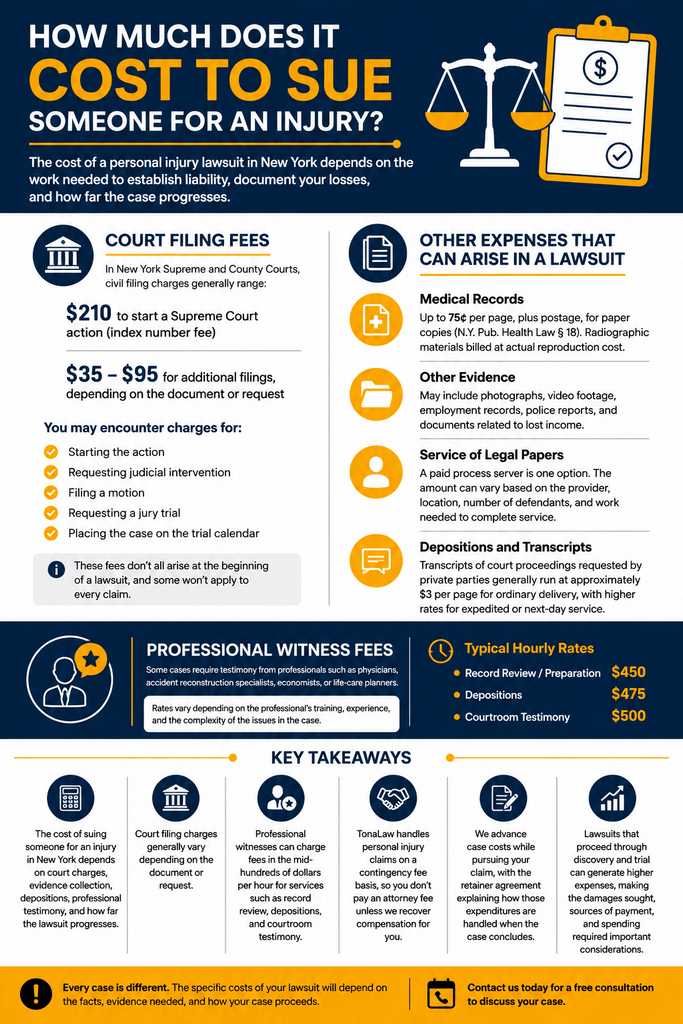
- The cost of suing someone for an injury in New York depends on court charges, evidence collection, depositions, professional testimony, and how far the lawsuit progresses.
- Court filing charges generally vary depending on the document or request.
- Professional witnesses can charge fees in the mid-hundreds of dollars per hour for services such as record review, depositions, and courtroom testimony.
- TonaLaw handles personal injury claims on a contingency fee basis, so you don’t pay an attorney fee unless we recover compensation for you.
- We advance case costs while pursuing your claim, with the retainer agreement explaining how those expenditures are handled when the case concludes.
- Lawsuits that proceed through discovery and trial can generate higher expenses, making the damages sought, sources of payment, and spending required to pursue the claim important considerations.
You’ve been injured in a car accident on the LIE, and have the medical bills, lost income, and damaged vehicle to show for it. While you want to seek compensation for these losses, you’re naturally concerned about the expense of litigation. No one would blame you for wondering, “How much does it cost to sue someone for an injury in New York?”
It actually depends. You’re likely looking at court fees, costs for medical record retrieval and depositions, and quite possibly expert witness fees. The amount is ultimately determined by what’s needed to establish liability and document your losses, as well as how far the personal injury lawsuit ends up going.
At TonaLaw, we handle personal injury cases on a contingency fee basis and advance case costs, so you don’t pay attorney fees or fund those expenses upfront. In this article, we’ll explain the costs associated with suing someone for an injury, when those charges arise, and how they can affect your personal injury settlement.
Court filing fees are among the first expenses associated with bringing a personal injury lawsuit. In New York Supreme and County Courts, civil filing charges generally range typically $210 to start a Supreme Court action in Nassau or Suffolk County (index number fee), with additional filings ranging from about $35 to $95 each, depending on the document or request. The New York State Unified Court System publishes these charges and identifies the provisions of the Civil Practice Law and Rules that authorize them.
You may encounter charges for:
- Starting the action
- Requesting judicial intervention
- Filing a motion
- Requesting a jury trial
- Placing the case on the trial calendar
These fees don’t all arise at the beginning of a lawsuit, and some won’t apply to every claim. As a result, the court charges associated with your case depend in part on how the litigation develops.
Please note that court fees represent only one portion of what it can cost to pursue an injury claim. Depositions, records, service of legal papers, professional testimony, and evidence preparation can add to the total. We’ll address those expenses separately so you can see where litigation costs originate and why the amount can vary between cases.
- Medical Records: Your medical records can document your diagnosis, treatment, test results, and recovery. New York law permits physicians and health care facilities to charge up to 75 cents per page, plus postage, for paper copies of medical records (see N.Y. Pub. Health Law § 18). Radiographic materials, such as X-rays and MRI films, may instead be billed at the actual reproduction cost.
- Other Evidence: Other evidence may include photographs, video footage, employment records, police reports, and documents related to lost income. The cost of obtaining this material depends on the source and amount requested.
- Service of Legal Papers: Everyone named in the lawsuit must receive their own set of papers, and a party to the lawsuit generally can’t serve them. A paid process server is one option for completing service. This amount can vary based on the provider, location, number of defendants, and work needed to complete service.
- Depositions and Transcripts: During a deposition, a witness answers questions under oath before trial. Transcripts of court proceedings requested by private parties generally run at approximately $3 per page for ordinary delivery, with higher rates for expedited or next-day service.
Some injury claims involve testimony from professionals in medicine, accident reconstruction, economics, vocational rehabilitation, or life-care planning. For example, a physician may address the cause and extent of an injury, while an accident reconstruction professional may analyze how a collision occurred. Economists and vocational professionals may address lost earning capacity, while life-care planners may assess future medical treatment and assistance.
Their work can include:
- Reviewing records
- Analyzing evidence
- Preparing reports
- Participating in depositions
- Testifying at trial
SEAK’s 2024 fee survey, which collected data from almost 1,600 respondents across over 250 fields, reports rates for file review, depositions, and trial testimony. According to the survey data, these charges may amount to hundreds of dollars per hour, although rates vary by field and service provided.
You don’t have to pay attorney fees upfront when TonaLaw represents you in a personal injury case. We use a contingency fee arrangement, which means our attorney fee depends on recovering compensation for you. If we obtain a settlement or court award, the fee is paid from the recovery rather than through hourly bills while your claim is pending.
For most New York personal injury claims, contingency fees are one-third of the amount recovered, depending on the fee arrangement. New York’s Second Judicial Department permits a contingency fee of up to one-third for personal injury claims other than medical, dental, or podiatric malpractice cases. The rules also address how qualifying expenses and disbursements are treated when the attorney’s fee is calculated.
At TonaLaw, we advance case costs while pursuing your personal injury claim. This allows us to investigate the accident, obtain evidence, and prepare the claim without asking you to pay those charges upfront. We pay expenses that include investigation costs, witness testimony, court fees, and other charges associated with pursuing your case.
These expenditures are addressed when the case concludes. Case costs are separate from our attorney fees and are reimbursed from the compensation we recover for you. Your contingency agreement explains how these charges are handled and deducted.
Please Note: New York’s Rules of Professional Conduct require a written contingency agreement to identify litigation expenses deducted from a recovery and state when the deduction occurs. It must also identify any expenses you must pay if there is no recovery. This information shows you how case costs can affect the amount you receive.
The amount spent pursuing a personal injury lawsuit largely depends on the work involved. A claim resolved before extensive discovery, for example, can generate fewer expenses than litigation involving depositions, professional testimony, disputed medical issues, or a trial. Several factors determine which expenses arise as we pursue your claim.
- The Number of Parties: A lawsuit involving several defendants can cost more. Each defendant must be served, which can mean further document requests, depositions, motions, and investigation. For example, a commercial vehicle collision may involve claims against a driver, employer, vehicle owner, or another party whose conduct contributed to the accident.
- Disputes Over Liability: When the parties disagree about who caused an accident, we may need more evidence to establish what happened. This can include witness testimony, photographs, surveillance footage, vehicle data, records, or accident reconstruction analysis. The work needed to obtain and present that evidence can increase litigation expenses.
- The Severity of Your Injuries: Serious injuries can require extensive medical documentation and testimony addressing your prognosis, future treatment, ability to work, and long-term limitations. If your claim includes future medical expenses or reduced earning capacity, we may need testimony from medical, vocational, or economic professionals to establish those losses.
- How Far the Lawsuit Progresses: A case that resolves during settlement negotiations can incur fewer expenses than one that proceeds through discovery and trial. Depositions, motions, subpoenas, trial exhibits, and professional testimony can add charges as litigation continues.
Generally speaking, yes. Preparing for court means organizing exhibits, preparing witnesses, arranging professional testimony, and presenting medical or technical information to a judge or jury. The resulting cost depends on what’s needed to establish liability and damages.
There isn’t a reliable cost range that applies to New York personal injury trials. Litigation requiring physicians and accident reconstruction professionals can cost more than a proceeding supported by fewer witnesses and records. Assigning a broad dollar estimate without knowing what your claim requires could misrepresent the amount needed to pursue it.
We also account for these expenditures when evaluating a settlement offer. Our assessment considers the proposed compensation, damages available through litigation, and spending required to continue pursuing the claim. Comparing those considerations helps us determine if proceeding to court serves your financial interests.
Are Litigation Costs Deducted From My Settlement?
Yes, case expenses are deducted from the compensation you receive. The retainer agreement determines how these charges are handled, including the point at which they are subtracted. This calculation affects the portion of a settlement or judgment paid to you.
In New York’s Second Judicial Department, which includes Long Island, contingency fee rules provide two methods for handling these expenditures. One method deducts allowable disbursements before calculating the attorney fee on the net recovery. Under the other, the lawyer pays those charges and calculates the percentage on the gross recovery before deductions. The retainer must describe both methods, explain their financial consequences, and identify the client’s selection.
Does a Free Consultation Mean My Lawsuit Won’t Have Any Costs?
No. A free consultation means you aren’t charged for the initial meeting. It doesn’t mean pursuing the claim has no expenses. At TonaLaw, we provide free consultations, handle personal injury cases on contingency, and advance case costs. If we recover compensation for you, attorney fees and applicable expenditures are handled according to the retainer agreement. The agreement explains how those deductions affect the amount distributed to you.
How much you pay to sue someone for an injury depends largely on the work involved. If you’ve been injured on Long Island or anywhere else in New York, we’d be happy to review your claim and explain our fee arrangement before representation begins. You can then see how attorney fees and litigation expenses will be handled as we pursue compensation on your behalf. Please call our law firm at 1-833-TONA-LAW or reach out online to schedule a free case review and take the first step toward turning your setback into a comeback.
SHARE


