
Key Takeaways
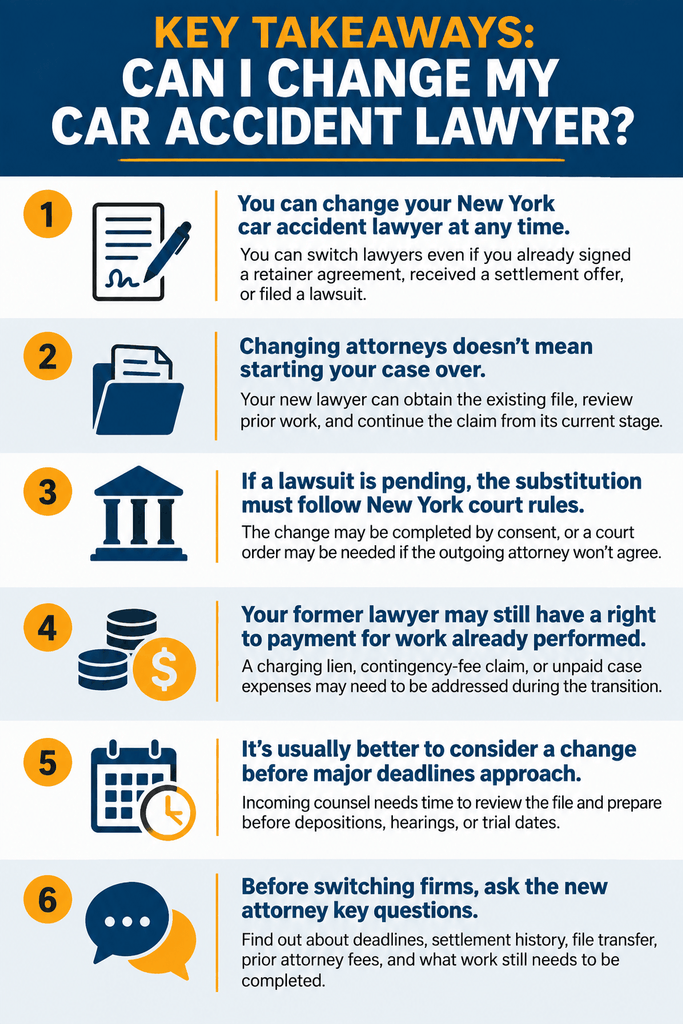
- You can change your New York car accident lawyer at any time, even if you already signed a retainer agreement, received a settlement offer, or filed a lawsuit.
- Changing attorneys doesn’t mean starting your case over. Your new lawyer can obtain the existing file, review prior work, and continue the claim from its current stage.
- If a lawsuit is pending, the substitution must follow New York court rules. The change may be completed by consent, or a court order may be needed if the outgoing attorney won’t agree.
- Your former lawyer may still have a right to payment for work already performed. A charging lien, contingency-fee claim, or unpaid case expenses may need to be addressed during the transition.
- It’s usually better to consider a change before major deadlines, depositions, hearings, or trial dates approach because incoming counsel needs time to review the file and prepare.
- Before switching firms, ask the new attorney about deadlines, settlement history, file transfer, prior attorney fees, and what work still needs to be completed.
You’ve hired a lawyer after a New York car accident, but aren’t satisfied with the representation. Do you have to see it through to the end of your case, or can you actually change your car accident lawyer?
The answer is yes. You aren’t required to stay with the same lawyer simply because you signed a retainer agreement or your claim is already underway. Changing lawyers also doesn’t mean you have to file your accident claim all over again. At TonaLaw, we have worked with many personal injury clients who weren’t satisfied with their previous representation and wanted to switch. This guide explains when you can change lawyers, what happens after you do, and what you should know before making the switch.
Yes, but there are some important steps involved. If your car accident claim hasn’t reached the litigation stage, changing lawyers may involve:
- Retaining new counsel
- Notifying your former attorney
- Transferring the case file
- Directing future insurance communications to the new firm
If a car accident lawsuit has already been filed, certain court procedures apply because your current lawyer is the attorney of record.
Under CPLR 321(b), a change of attorney can be completed by filing a consent form signed by the outgoing lawyer and acknowledged by the client. (If the outgoing attorney won’t consent, the substitution may need a court order.) Your new Long Island car accident lawyer can handle these filings and review any pending deadlines, discovery obligations, depositions, motions, or court appearances before taking over the case.
You also don’t have to wait for a particular stage in the claim before considering a change. You may seek new representation during insurance negotiations, after a lawsuit has been filed, or while a settlement offer is pending. But the timing can affect how the transition is handled, especially when court dates or other deadlines are approaching.
Not every disagreement means you need a new attorney, but ongoing problems can make it difficult to continue the relationship. A car accident case may last months or longer, so you need to know who is handling your claim, what has been done, and what needs to happen next.
Common reasons clients consider changing lawyers include:
- Your Lawyer Rarely Communicates With You: You may go weeks without a return call, receive little information after asking for an update, or have trouble reaching anyone who can explain what is happening. Your attorney doesn’t need to contact you constantly, but you should be able to obtain meaningful updates when you have reasonable questions about your case.
- You Don’t Know the Status of Your Claim: You may not know if medical records have been requested, a demand has been sent, a lawsuit has been filed, discovery is underway, or the insurance company has made an offer. If you repeatedly ask for this information and still can’t get a direct answer, you may decide to speak with another attorney.
- Your Questions Aren’t Being Answered: Car accident claims can involve medical treatment, no-fault benefits, lost wages, insurance limits, liens, settlement negotiations, and court deadlines. You should be able to ask questions about these issues and receive answers that address your concerns.
- Your Case Appears to Have Stalled: Some delays have legitimate causes, including ongoing medical treatment, insurer response times, court scheduling, and discovery deadlines. The concern is when months pass without progress and no one can explain what is causing the delay or what is being done next.
- You Disagree With the Settlement Strategy: Your attorney can advise you about the risks and potential value of a settlement, but the decision to accept an offer is yours. If you believe you are being pressured to accept an amount you don’t agree with, or you aren’t receiving a clear explanation of the recommendation, you may want another lawyer to review the case.
- You No Longer Trust Your Attorney: Trust is central to the attorney-client relationship. If repeated communication problems, missed commitments, lack of preparation, or disagreements about how the case is being handled have damaged that trust, changing lawyers may be appropriate.
No. In New York, you may end the attorney-client relationship at any time, even if your lawyer hasn’t committed misconduct. You don’t have to prove negligence, an ethical violation, or another form of wrongdoing before hiring different counsel.
The reason for the change can still affect attorney fees, however. New York distinguishes between a lawyer who is discharged without cause and one who is discharged for cause. If you change your attorney without cause, the former lawyer may still have a right to payment for any work already performed. But if a court determines that the attorney was discharged for cause, the lawyer may lose the right to collect a fee for that representation.
It is important to note that discharge for cause is a legal determination. Poor communication, disagreement over strategy, or dissatisfaction with the pace of a case doesn’t necessarily mean the attorney was discharged for cause. Courts look at their conduct and the overall situation when deciding this issue. For that reason, it’s important to separate your right to change lawyers from any later dispute over fees.
Changing lawyers doesn’t mean you will pay two full contingency fees. If your former attorney was discharged without cause, that lawyer may still have a right to payment for the work completed before the representation ended. New York Judiciary Law § 475 also gives an attorney a charging lien that can attach to a settlement, judgment, award, or other recovery in the case.
When a contingency fee case moves from one law firm to another, the attorneys may need to determine how the eventual fee will be divided. Depending on the situation, the outgoing attorney may seek payment based on the reasonable value of the services already performed or a proportionate share of the contingency fee. New York courts can consider the time spent on the case, the work each lawyer performed, the difficulty of the legal issues, and each attorney’s contribution to the result.
You should also distinguish attorney fees from case expenses. Your former firm may have paid expenses such as:
- Court filing fees
- Medical record charges
- Deposition transcript fees
- Accident investigation expenses
- Expert witness fees
- Service fees
- Other litigation expenses
When we review a case that another attorney has been handling, we can examine the existing retainer agreement, the work already completed, outstanding expenses, and any attorney lien that has been asserted. This helps determine how the prior fee arrangement may affect the case before TonaLaw takes over the representation.
Your new attorney needs the existing case file so the representation can continue without unnecessary duplication. Depending on how far the case has progressed, the file may include:
- Police accident reports
- Photographs and video footage
- Witness statements and contact information
- Insurance policies and correspondence
- No-fault applications and benefit records
- Medical records and bills
- Employment and wage-loss records
- Accident investigation materials
- Settlement demands and responses
- Settlement offers and counteroffers
- Pleadings filed with the court
- Discovery demands and responses
- Deposition transcripts
- Medical examination reports
- Expert reports
- Court orders and scheduling notices
You usually won’t need to collect all of these materials yourself. Once you retain new counsel, the incoming firm can contact your former attorney and arrange for the file to be transferred.
The timing of that transfer can be especially important if your lawsuit already has scheduled depositions, discovery deadlines, motion dates, medical examinations, conferences, or a trial date. Your new lawyer needs enough time to review what has already happened and determine what still needs attention.
Your new attorney will need to review the litigation file as soon as possible. That review may include:
- The summons and complaint
- The defendant’s answer
- Discovery demands and responses
- Deposition notices and transcripts
- Independent medical examination notices
- Motions and opposition papers
- Court conference orders
- Settlement correspondence
- Expert disclosures
- Scheduled hearings or conferences
- The trial date, if one has been set
If a deposition, motion deadline, conference, or trial date is approaching, timing is especially important. A new attorney needs enough time to obtain the file, review prior work, prepare for upcoming events, and address any unfinished tasks. At TonaLaw, we can review the litigation history before accepting the case and determine what must be handled immediately after the substitution.
- Speak With Another Personal Injury Lawyer: Explain why you are considering a change and provide information about the collision, your car accident injuries, medical treatment, insurance claims, settlement discussions, and any pending court dates.
- Have the New Lawyer Review the Case: Before taking over the representation, the new attorney should determine what work has already been completed, what deadlines are approaching, and what issues still need attention.
- Review Your Current Retainer Agreement: Your existing agreement may address the contingency fee, case expenses, termination of representation, and other terms that affect the transition.
- Retain the New Firm: Once the new attorney agrees to accept the case, you will sign a new retainer agreement. This establishes the new attorney-client relationship before the prior representation ends.
- Notify Your Current Lawyer: Your former attorney should receive written notice that you are ending the representation. In many cases, the new firm can handle this communication for you.
- Arrange for the File Transfer: Your new attorney can request the case file from your former lawyer, including medical records, insurance correspondence, pleadings, discovery materials, settlement communications, and other documents.
- Complete Any Required Court Filing: If a lawsuit has already been filed, the substitution must comply with CPLR 321(b). When the outgoing attorney agrees to the change, the required consent can be filed. If there is no consent, court approval may be necessary.
- Redirect Future Communications: Insurance companies, defense attorneys, medical providers, and other parties involved in the case may need to be notified that future communications should go to the new firm.
Can I Change Lawyers if a Settlement Offer Has Already Been Made?
Yes. A pending settlement offer doesn’t prevent you from changing car accident lawyers. You still control the decision to accept or reject the offer, and your attorney can’t accept a settlement without your authorization.
Timing is especially important if you have already authorized acceptance of an offer or signed settlement papers. Once a settlement becomes binding, changing attorneys may not undo the agreement. If you are considering new counsel because you disagree with the proposed settlement, speak with another lawyer before accepting the offer or signing release documents.
Will Changing Lawyers Hurt My Car Accident Case?
Changing attorneys doesn’t erase the work already completed or give the defendant a new defense against your claim. Your case continues from its current stage, and the incoming lawyer can use the records, evidence, pleadings, and other materials already developed.
The transition still needs to be handled carefully, though. Problems can arise if:
- A deadline passes while representation is changing
- The prior firm delays transferring the file
- Important records are missing from the file
- A deposition, hearing, or trial date is approaching
- Discovery responses are incomplete
- The new attorney needs additional time to review the case
A change in counsel may also affect timing. The new attorney may need to review prior strategy, confirm the status of insurance claims, examine medical documentation, study deposition testimony, and determine what work remains before moving forward.
Before TonaLaw accepts an existing case, we can review where the claim stands and identify any immediate deadlines or unresolved issues. That allows us to determine what needs attention if we take over the representation.
If you are unhappy with your current car accident lawyer, you don’t have to remain in that attorney-client relationship until the case ends. You can speak with another lawyer, have your file reviewed, and decide if changing firms is the right choice for you.
At TonaLaw, we can review the current status of your New York car accident claim, including prior settlement negotiations, medical records, insurance issues, court filings, upcoming deadlines, attorney liens, and case expenses. If we agree to take over the representation, we can coordinate the file transfer and handle the required substitution paperwork when a lawsuit is already pending. Please call our law firm at 1-833-TONA-LAW or reach out online to schedule a free case review and take the first step toward turning your setback into a comeback.
SHARE


