
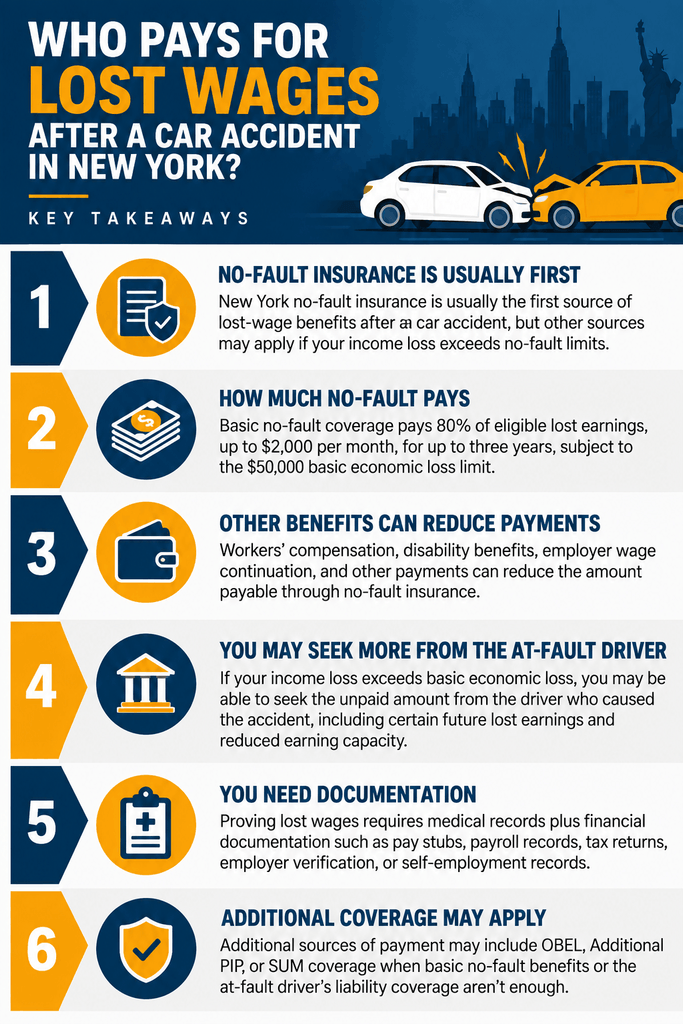
Key Takeaways
- New York no-fault insurance is usually the first source of lost wage benefits after a car accident, but other sources may apply if your income loss exceeds no-fault limits.
- Basic no-fault coverage pays 80% of eligible lost earnings, up to $2,000 per month, for up to three years, subject to the $50,000 basic economic loss limit.
- Workers’ compensation, disability benefits, employer wage continuation, and other payments can reduce the amount payable through no-fault insurance.
- If your income loss exceeds basic economic loss, you may be able to seek the unpaid amount from the driver who caused the accident, including certain future lost earnings and reduced earning capacity.
- Proving lost wages requires medical records plus financial documentation such as pay stubs, payroll records, tax returns, employer verification, or self-employment records.
- Additional sources of payment may include OBEL, Additional PIP, or SUM coverage when basic no-fault benefits or the at-fault driver’s liability coverage aren’t enough.
If a New York car accident keeps you from working, the income loss can begin before your medical treatment ends. You may miss entire workdays, lose overtime or commissions, work fewer hours, or remain out of work for weeks or months. New York’s no-fault insurance system provides lost wage benefits for eligible crash victims, but there are payment limits and conditions involved.
At TonaLaw, we help injured New Yorkers identify which insurance coverage may pay their lost earnings. Depending on your situation, payment may come from no-fault insurance, workers’ compensation, optional auto coverage, or a claim against the driver who caused the crash. This guide explains who pays lost wages after a New York car accident, how no-fault wage benefits are calculated, and when you may pursue income losses beyond basic benefits.
In New York, no-fault insurance is usually the first source of payment for lost wages after a car accident. You don’t have to prove that another driver caused the crash before you can claim eligible no-fault wage benefits. If your injuries prevent you from working, the applicable no-fault insurer may pay part of the income you lose while you recover.
The insurer responsible for the claim depends on your role in the accident:
- Drivers and Passengers: If you were driving or riding in a vehicle, you usually seek no-fault benefits through the insurer for that vehicle.
- Pedestrians: If a vehicle struck you while you were walking, you usually seek no-fault benefits through the insurer for the vehicle that hit you.
- Employees Injured While Working: If the crash happened while you were performing job duties, workers’ compensation may also pay wage-replacement benefits. Those payments can affect the amount payable through no-fault insurance.
No-fault benefits don’t always replace all of the income you lose. New York limits basic lost earnings benefits, and higher earners may reach the monthly cap while still losing money. You may also exhaust available basic economic loss benefits before you return to work.
When your recoverable income loss exceeds New York’s basic economic loss limits, the driver who caused the accident may become responsible for the excess through a liability claim. Depending on the insurance policies involved, supplementary uninsured or underinsured motorist coverage may also apply when the responsible driver doesn’t have enough liability coverage to pay.
New York no-fault insurance pays 80% of eligible lost earnings, subject to a maximum benefit of $2,000 per month. These payments can continue for up to three years from the date of the accident, but they stop sooner if you return to work, your medical records no longer support your inability to work, or you exhaust the available no-fault benefits.
For example, if you normally earn $2,000 per month and miss a full month of work because of your injuries, 80% of that income is $1,600. If you normally earn $5,000 per month, 80% is $4,000, but basic no-fault coverage still limits the payment to $2,000 for that month.
The $50,000 basic economic loss limit also applies across several categories of no-fault benefits. It isn’t a separate $50,000 allowance for lost wages: medical expenses and certain other qualifying costs can all draw from the same basic amount.
This can be an issue when you need extensive medical treatment and remain unable to work for a long period. Medical bills may use a large portion of the available no-fault benefits before your wage loss ends, leaving part of your income loss unpaid through basic PIP.
No. New York basic no-fault insurance doesn’t replace your full paycheck in many cases. As we mentioned in the previous section, the benefit is limited to 80% of eligible lost earnings, up to $2,000 per month.
That cap can create a large gap for higher earners. If you earn $6,000 per month and can’t work for two months, your gross income loss is $12,000. Basic no-fault coverage would pay no more than $4,000 in lost earnings benefits for those two months, before any applicable offsets.
You may also lose income that isn’t reflected in your base salary. Depending on your employment history, a wage loss claim may include regular overtime, commissions, bonuses, or other earnings you would have received if the accident hadn’t kept you from working.
The amount no-fault pays and the amount you actually lose aren’t always the same. If your recoverable income loss exceeds New York’s basic economic loss limits, the unpaid portion may be included in a claim against the driver who caused the accident.
Other wage replacement benefits can reduce what no-fault insurance pays for lost earnings. New York law subtracts certain amounts that you recover or can recover from other sources when those benefits replace the same income loss.
Common examples include:
- Workers’ Compensation Benefits: If you were injured while performing job duties, workers’ compensation wage benefits may reduce the amount payable through no-fault insurance.
- New York Disability Benefits: Disability payments may affect the no-fault calculation when they replace income lost because you can’t work.
- Social Security Disability Benefits: Certain disability payments can also be considered when calculating first-party benefits.
- Employer Wage Continuation: If your employer continues paying your salary while you’re out of work, that payment may affect the amount you can claim through no-fault insurance.
Sick leave, vacation time, paid time off, salary continuation, and disability benefits don’t all receive the same treatment in every claim. The result depends on how the benefit is paid and if using it reduces your future entitlement to that benefit.
For that reason, you shouldn’t assume that every payment you receive after the accident can be added on top of no-fault lost wage benefits. Our Long Island car accident lawyers can review the source of each payment and determine how it affects the amount you may still claim.
If you were injured in a car accident while performing your job duties, you may have both a New York workers’ compensation claim and a no-fault claim. Examples include delivery drivers, employees traveling between job sites, sales representatives driving to appointments, and workers running errands for an employer.
Workers’ compensation can pay part of your lost earnings when the accident arose out of and occurred during your employment. New York no-fault law allows certain workers’ compensation benefits to be deducted when calculating first-party benefits, so you can’t receive duplicate payment for the same wage loss.
This means the two claims need to be reviewed together. Your workers’ compensation payments, no-fault benefits, medical restrictions, earnings history, and dates missed from work can all affect how much you receive.
Note: If another driver caused the crash, you may also have a third-party claim for income losses that fall outside New York’s basic economic loss limits. TonaLaw can evaluate each available source of payment and determine which losses remain unpaid.
Yes. If your income loss exceeds New York’s basic economic loss limits, you may be able to seek the unpaid amount from the driver who caused the accident.
New York Insurance Law § 5104 prevents a person insured under the no-fault system from recovering basic economic loss from another covered person in a negligence claim. Once your economic losses exceed that category, the excess may be recoverable through a liability claim.
Recoverable excess income losses may include:
- Earnings Above the No-Fault Monthly Limit: If you earn more than the amount basic PIP can replace, the unpaid difference may be recoverable.
- Income Lost After Basic No-Fault Benefits Are Exhausted: If your available PIP benefits run out while you’re still unable to work, later wage losses may fall outside basic economic loss.
- Future Lost Earnings: If your injuries keep you from returning to the same work or earning the same income, future losses may be included.
- Reduced Earning Capacity: A lasting injury may limit the hours you can work, the duties you can perform, or the type of employment you can pursue.
Note: A serious injury finding isn’t required solely to pursue economic loss that exceeds basic economic loss. New York’s serious injury threshold applies to claims for non-economic damages such as pain and suffering, while excess economic loss is treated separately under the no-fault statute.
Useful documentation may include:
- Medical Work Restrictions: Your doctor’s records should state when your injuries prevented you from working and identify any limits on your job duties or hours.
- Pay Stubs and Payroll Records: These records can show your regular earnings before the accident and the income you lost afterward.
- Employer Verification: Your employer may need to confirm your wages, work schedule, dates missed, and any salary or benefits paid while you were out of work.
- Tax Records: W-2 forms and tax returns can help document prior earnings, particularly when your income varies from year to year.
- Commission, Bonus, and Overtime Records: If these payments were a regular part of your compensation, prior payroll records may help establish the amount you lost.
- New York No-Fault Forms: Employers may be asked to complete Form NF-6, the Employer’s Wage Verification Report, as part of a no-fault wage-loss claim.
Self-employed workers need different records because they don’t have an employer verifying their income. New York’s NF-7 form addresses self-employment income and asks for information about the business, the period you couldn’t work, replacement workers, and the resulting income loss.
If you’re self-employed, supporting records may include tax returns, profit-and-loss statements, invoices, contracts, bank records, cancelled appointments, and proof of work you couldn’t complete because of your injuries. Gross business revenue by itself doesn’t establish your personal lost earnings, so the records need to show the income you actually lost because you couldn’t work.
How Does Fault Affect a Claim for Additional Lost Wages?
Fault becomes important when you seek lost income from another driver rather than through no-fault insurance. To recover excess economic losses from another party, you must establish that the other party was legally responsible for the collision.
New York changed its comparative negligence rule for motor vehicle personal injury actions in 2026. For actions subject to Insurance Law Article 51 commenced on or after May 26, 2026, you can’t recover damages if your share of fault is greater than the fault of the person you’re suing, or greater than the combined fault of all defendants.
If your share of fault is 50% or less, you may still recover damages, but your award is reduced by your percentage of responsibility. For example, if you have $40,000 in recoverable excess lost income and you’re found 25% at fault, that portion of your damages would be reduced by 25%.
What If the At-Fault Driver Doesn’t Have Enough Insurance?
The at-fault driver may not have enough liability insurance to pay all of your lost income. This can happen when your injuries keep you out of work for an extended period or reduce your future earning capacity.
Supplementary uninsured/underinsured motorist coverage (commonly called SUM coverage in New York) may provide another source of compensation. SUM coverage can apply when the responsible driver has no insurance or carries liability limits that are too low to pay the damages you can legally recover.
A SUM claim can include qualifying economic loss that exceeds basic economic loss. The amount available depends on the policy limits, the liability coverage available from the at-fault driver, and the terms of the applicable policy.
Before pursuing a SUM claim, the available auto policies should be reviewed carefully. TonaLaw can determine which policies apply, compare the available limits, and identify the remaining lost income damages that may be recoverable.
Can Additional PIP Coverage Pay More Lost Wages?
Yes. Some New York auto policies include optional coverage that can pay benefits beyond the mandatory no-fault limits.
One example is Optional Basic Economic Loss coverage, or OBEL. New York permits drivers to purchase an additional $25,000 in basic economic loss coverage. After the standard $50,000 in basic no-fault benefits is exhausted, OBEL may be applied to qualifying losses according to the policy terms and the insured’s election.
Some policies also include Additional Personal Injury Protection coverage. The amount and type of benefits depend on the policy, so the declarations page and endorsements should be reviewed before calculating how much wage loss coverage is available.
If a New York car accident has kept you from working, your lost income may be covered by no-fault benefits, additional auto coverage, and a claim against the driver who caused the crash. TonaLaw can review your wage records, insurance policies, and accident claim to determine which sources of compensation may apply. Please call our law firm at 1-833-TONA-LAW or reach out online to schedule a free case review and take the first step toward turning your setback into a comeback.
SHARE


