
Key Takeaways
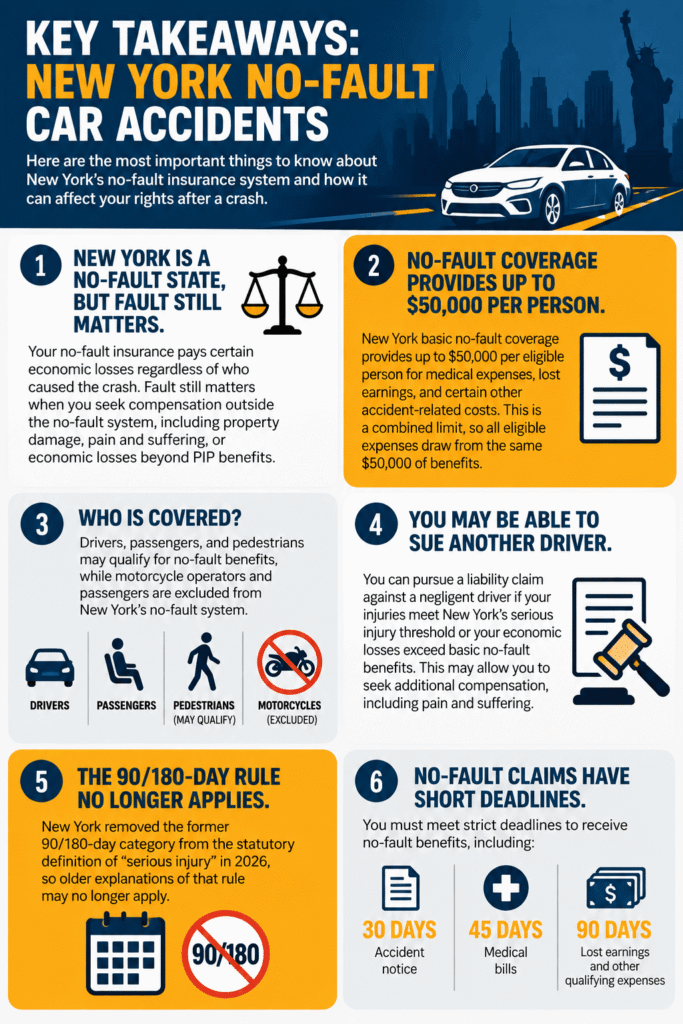
- New York is a no-fault state, but fault still matters when you seek compensation outside the no-fault system, including property damage, pain and suffering, or economic losses beyond PIP benefits.
- New York basic no-fault coverage provides up to $50,000 per eligible person for medical expenses, lost earnings, and certain other accident-related costs.
- Drivers, passengers, and pedestrians may qualify for no-fault benefits, while motorcycle operators and passengers are excluded from New York’s no-fault system.
- You may pursue a liability claim against a negligent driver if your injuries meet New York’s serious injury threshold or your economic losses exceed basic no-fault benefits.
- New York removed the former 90/180-day category from the statutory definition of “serious injury” in 2026, so older explanations of that rule may no longer apply.
- No-fault claims have short deadlines, including 30 days for accident notice, 45 days for medical bills, and 90 days for lost earnings and other qualifying expenses.
New York is a no-fault auto insurance state, which leads many motorists to believe that fault doesn’t factor into an accident claim at all. The reality is that fault can still matter when you seek payment for vehicle damage or your injuries meet New York’s serious injury threshold.
At TonaLaw, we represent people injured in New York motor vehicle accidents, including claims involving no-fault benefits and claims against negligent drivers. This article explains what New York no-fault insurance pays, who can receive benefits, when fault still affects your recovery, and when you may sue another driver after a crash.
Under New York’s no-fault system, drivers, passengers, and other parties injured in a car accident must turn to their own insurance policy for compensation regarding medical bills and economic losses, regardless of who caused the crash. Liability becomes important only when you seek compensation outside the no-fault system in defined situations.
The purpose of no-fault coverage is to cover your economic losses after a motor vehicle accident. This includes qualifying medical expenses, part of your lost wages, and certain other necessary expenses related to your injuries. Basic no-fault coverage in New York provides up to $50,000 per eligible person for basic economic loss.
New York’s basic no-fault coverage provides up to $50,000 per eligible injured person for basic economic loss. That $50,000 is a combined limit, so medical expenses, lost earnings, and qualifying out-of-pocket costs draw from the same pool of benefits. If your medical bills consume most of the available coverage, less may remain for wage loss or other eligible expenses.
Medical and Rehabilitation Expenses
No-fault insurance can pay reasonable and necessary medical expenses caused by the accident. Eligible charges can include:
- Hospital treatment
- Physician services
- Diagnostic testing
- Prescription medication
- Ambulance transportation
- Physical therapy
- Occupational therapy
- Other authorized medical care
The treatment must be related to injuries from the crash. Medical expenses can use a large share of the $50,000 limit when an injury requires surgery, repeated imaging, rehabilitation, or months of treatment. Once available no-fault benefits are exhausted, another source of payment may be necessary. Depending on your insurance and claim, that may include health insurance, additional PIP coverage, or a liability claim against the person who caused the accident.
Lost Earnings
No-fault insurance can also replace part of the income you lose after being injured. New York provides 80% of qualifying lost earnings, subject to a maximum of $2,000 per month for up to three years from the accident. (That amount may also be reduced by payments available from other sources.)
The $2,000 monthly cap means no-fault benefits may replace only a fraction of your income if you earn more. You’ll need documentation showing your earnings and the time you were unable to work because of your injuries.
Other Reasonable and Necessary Expenses
No-fault coverage can reimburse certain other reasonable and necessary expenses caused by the accident. New York allows up to $25 per day for these expenses for no more than one year from the crash. Examples can include transportation to medical appointments or household assistance.
You should keep receipts, invoices, mileage records, and other documentation, as insurers can ask for proof before issuing payment. An expense that falls outside the statutory categories or lacks adequate documentation may not qualify for reimbursement.
Death Benefit
New York no-fault coverage also includes a $2,000 death benefit. This amount, which is payable to the deceased person’s estate, is separate from the $50,000 basic economic loss limit.
New York no-fault benefits can apply to more than the policyholder. Coverage may also extend to drivers, passengers, and pedestrians injured in motor vehicle accidents. Which insurer pays your claim depends on how you were involved in the crash.
- If you were driving or riding in a vehicle, you usually file the no-fault claim with the insurer for that vehicle.
- If you were a pedestrian, you usually file with the insurer for the vehicle that struck you.
- If an uninsured or unidentified vehicle was involved, another policy or the Motor Vehicle Accident Indemnification Corporation may apply.
Coverage can become more difficult to sort out when several vehicles or insurance policies are involved. The same is true when the injured person lives with someone who has separate auto coverage, but a Long Island car accident lawyer can help determine which policies may apply.
As a general rule motorcycle operators and passengers are excluded from New York’s no-fault benefits. If you’re injured while riding a motorcycle, you can’t rely on Personal Injury Protection to pay your medical bills or lost earnings unless additional insurance was purchased when the motorcycle was being insured.
That exclusion also changes how an injury claim can proceed. A motorcycle rider injured by a negligent driver doesn’t have to satisfy New York’s serious injury threshold before seeking compensation for pain and suffering.
Pedestrians are treated differently. If you’re struck by a motorcycle, you may still have a no-fault claim against the motorcycle’s insurer. Your status at the time of the crash can therefore determine which insurance rules apply.
Yes. New York’s no-fault system changes how certain injury benefits are paid, but it does not eliminate fault from every claim. Liability still matters when you seek compensation from the driver or other party that caused the crash.
Fault can affect claims involving:
- Vehicle damage
- Other property damage
- Pain and suffering
- Economic losses that exceed no-fault benefits
- Other damages available in a liability claim
To recover from another party, you must show that the person was negligent and that their conduct caused your injuries or losses. You can receive no-fault benefits without proving who caused the collision, but a liability claim needs proof that another party was legally responsible.
New York limits pain and suffering claims after many motor vehicle accidents to people who meet the statutory serious injury threshold. Under Insurance Law § 5102(d), the current categories include:
- Death
- Dismemberment
- Significant disfigurement
- Fracture
- Loss of a fetus
- Permanent loss of use of a body organ, member, function, or system
- Permanent consequential limitation of use of a body organ or member
- Significant limitation of use of a body function or system
A diagnosis by itself may not establish serious injury. Medical records, imaging, physician findings, and documented functional limitations can become important when an insurer disputes the claim.
Note: New York removed the former 90/180-day category from the definition of “serious injury” in 2026. That category previously applied to certain non-permanent injuries that prevented a person from performing substantially all of their usual daily activities for at least 90 of the first 180 days after the accident.
The $50,000 no-fault limit can be exhausted by medical bills, lost earnings, and other expenses. If that happens, you may have other sources of payment. The options depend on your insurance coverage and your right to pursue the person who caused the crash.
- New York allows drivers to purchase an additional $25,000 in Optional Basic Economic Loss, or OBEL, coverage. This coverage applies after the initial $50,000 has been exhausted. Depending on the election made under the policy, the additional benefits may be used for qualifying economic losses, lost earnings, rehabilitation expenses, or a combination of those categories.
- Additional PIP coverage may also be available if it was purchased under the policy.
- Health insurance may pay eligible medical expenses after no-fault coverage ends.
- If another driver caused the crash, you may also be able to seek economic losses that exceed basic no-fault benefits through a liability claim.
- Get Medical Care: Seek treatment for your injuries and tell your providers how the crash occurred. Keep copies of medical records, bills, prescriptions, and referrals.
- Report the Accident: Notify the appropriate insurer as soon as possible. This helps start the no-fault claim within the 30-day notice period.
- Preserve Evidence: Save photographs, video, witness information, police reports, and insurance information from the drivers involved.
- Track Your Expenses: Keep records of medical costs, lost income, transportation expenses, and other eligible losses.
- Follow Treatment Instructions: Attend appointments and follow medical restrictions. Gaps in treatment can make it harder to document the extent of your injuries.
- Speak With a Long Island Car Accident Lawyer: A lawyer can review the insurance policies, identify the deadlines that apply, and determine if you have a claim against another driver. This can be especially important when your injuries are serious or your losses exceed available no-fault benefits.
Does No-Fault Pay for Damage to Your Car?
No. New York no-fault insurance pays for injury-related and economic losses, not damage to your vehicle or other property. Property damage claims are handled separately from PIP benefits.
If you have collision coverage, you may be able to file a claim under your own policy for vehicle repairs. You may also pursue the at-fault driver’s property damage liability coverage when another driver caused the crash.
For example, if another driver runs a red light and damages your car, no-fault benefits won’t pay the repair bill. Your property damage claim must be handled through collision coverage or the responsible driver’s liability insurance.
How Does Comparative Fault Affect a New York Accident Claim?
In 2026, New York shifted from a pure comparative fault state to a modified comparative negligence rule for motor vehicle liability claims. This means your compensation can be reduced if you share responsibility for the crash. But for lawsuits filed after May 26, 2026, you cannot recover damages if your share of fault is greater than the other driver’s in a motor vehicle accident. For all lawsuits filed prior to that date, pure comparative negligence rules will still be applied.
For example, suppose your total damages are $200,000 and you are found 20% at fault. Your recovery would be reduced by 20%, leaving $160,000. The same rule applies when fault is divided among several parties. If you are 60% at fault, and the lawsuit was filed before May 26, 2026 you would still be able to recover 40% or $80,000. If the lawsuit was filed after that date, you would not be able to recover and money for your injuries.
Fault does not determine your eligibility for no-fault benefits: it only becomes relevant when you pursue compensation from another party. That is another reason the no-fault claim and the liability claim must be treated separately.
How Long Do You Have to File a New York No-Fault Claim?
New York no-fault claims have short filing deadlines.
You usually must give written notice of the accident to the insurer within 30 days, while medical bills must be submitted within 45 days after treatment.
Claims for lost earnings and other qualifying expenses must be submitted within 90 days after the loss is incurred.
Missing one of these deadlines can affect payment, although an insurer may accept a late submission if you have a reasonable justification.
Note: These deadlines apply to no-fault benefits. If you have a personal injury claim against another driver, a separate statute of limitations can apply. That makes it important to treat the insurance claim and any liability claim as two different deadlines.
A New York car accident can involve both a no-fault claim and a separate claim against the negligent driver. At TonaLaw, we can review the available insurance coverage, the extent of your injuries, and the losses you have sustained. We can also determine whether your case meets the serious injury threshold or supports a claim for economic losses beyond basic no-fault benefits. Please call our law firm at 1-833-TONA-LAW or reach out online to schedule a free case review and take the first step toward turning your setback into a comeback.
SHARE


