
Key Takeaways
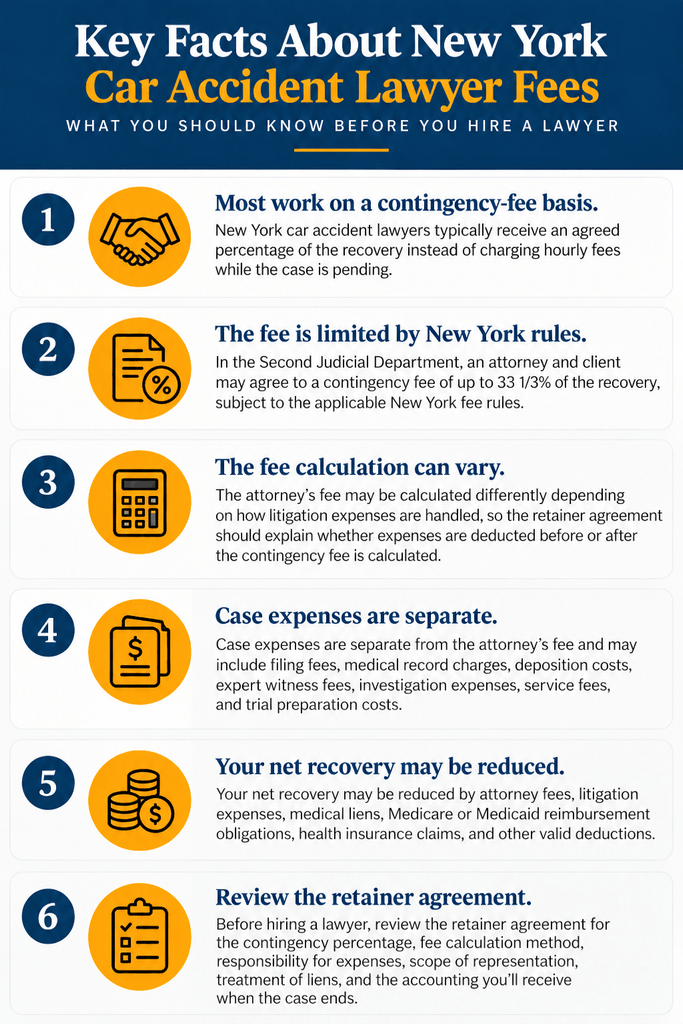
- New York car accident lawyers typically work on a contingency-fee basis, which means the attorney receives an agreed percentage of the recovery instead of charging hourly fees while the case is pending.
- In the Second Judicial Department, an attorney and client may agree to a contingency fee of up to 33⅓% of the recovery, subject to the applicable New York fee rules.
- The attorney’s fee may be calculated differently depending on how litigation expenses are handled, so the retainer agreement should explain whether expenses are deducted before or after the contingency fee is calculated.
- Case expenses are separate from the attorney’s fee and may include filing fees, medical record charges, deposition costs, expert witness fees, investigation expenses, service fees, and trial preparation costs.
- Your net recovery may be reduced by attorney fees, litigation expenses, medical liens, Medicare or Medicaid reimbursement obligations, health insurance claims, and other valid deductions.
- Before hiring a lawyer, review the retainer agreement for the contingency percentage, fee calculation method, responsibility for expenses, scope of representation, treatment of liens, and the accounting you’ll receive when the case ends.
If you’re considering hiring a lawyer after a New York car accident, you may be concerned about the cost of representation. If your medical bills are mounting and you can’t work to pay them, how can you afford to hire a Long Island car accident lawyer?
The good news is that most personal injury firms don’t bill car accident clients by the hour. Instead, the attorney receives a percentage of any compensation recovered through settlement or litigation, allowing you to pursue a claim without paying ongoing legal fees.
At TonaLaw, we handle car accident claims on a contingency fee basis. New York court rules regulate these agreements and place limits on the percentage an attorney may charge in a personal injury case. This article explains how New York car accident lawyer fees work, how contingency fees differ from case expenses, and what you should review before agreeing to representation.
A contingency fee means your attorney’s compensation depends on obtaining a financial recovery for you. This arrangement allows you to pursue a personal injury claim without paying recurring attorney fees while the case is being investigated, negotiated, or litigated.
The contingency percentage should be stated in the written retainer agreement you sign at the beginning of the representation. That agreement should also explain how case expenses will be handled, including filing fees, medical record charges, deposition costs, expert fees, and other litigation expenses. Those expenses are separate from the attorney’s fee, so you should review how each category will be paid and deducted from any recovery.
If your attorney obtains compensation through an insurance settlement, a settlement after filing suit, or a judgment following trial, the agreed contingency fee is deducted according to the terms of the retainer. If there is no recovery, the attorney doesn’t earn the contingency fee. Your responsibility for case expenses may be different, however, which is why the retainer should state what happens to those costs if the claim doesn’t result in compensation.
New York regulates contingency fees in personal injury cases, including claims arising from car accidents. Under the fee schedule used in the Second Judicial Department, which includes Long Island, an attorney and client may agree at the beginning of the representation to a contingency fee of up to 33⅓% of the amount recovered. A fee that exceeds the permitted schedule is treated as unreasonable unless a court authorizes it.
New York also recognizes an alternative graduated fee schedule. Under that option, the attorney may receive 50% of the first $1,000 recovered, 40% of the next $2,000, 35% of the next $22,000, and 25% of any amount above $25,000. These schedules are alternatives, so the attorney doesn’t add the graduated percentages to a separate one-third contingency fee.
For many car accident clients, the percentage stated in the retainer agreement is the figure they will use when evaluating the cost of representation. A 33⅓% contingency fee means that, before accounting for the treatment of litigation expenses or other deductions, the attorney’s fee on a $150,000 recovery would be $50,000. The remaining $100,000 wouldn’t necessarily be the client’s final payment because medical liens, reimbursement claims, and case expenses may still have to be addressed.
The written retainer agreement should identify the fee arrangement before legal representation begins. It should also explain how expenses affect the fee calculation because New York allows different methods for calculating the contingency percentage, depending on how those expenses are handled.
The answer depends on how the retainer agreement treats litigation expenses. Under the Second Judicial Department’s contingency fee rule, the attorney and client may use one of two permitted methods for calculating the fee. The difference is important because deducting expenses before the fee calculation can produce a different result than calculating the percentage from the full recovery.
Under one method, litigation expenses are deducted from the recovery before the contingency fee is calculated. For example, assume a case settles for $150,000 and includes $6,000 in qualifying expenses. After subtracting those expenses, the remaining amount is $144,000, so a 33⅓% fee would be approximately $48,000. The client would then have $96,000 remaining before any medical liens, insurance reimbursement claims, or other deductions are addressed.
Under the second method, the attorney pays the litigation expenses and calculates the contingency fee from the gross recovery. Using the same $150,000 settlement, a 33⅓% fee would be approximately $50,000. The applicable expenses would then be handled according to the retainer agreement, which can reduce the amount ultimately distributed to the client.
Because these methods produce different results, the retainer agreement should state which calculation applies. New York’s rule requires the agreement to explain the available methods and their financial consequences so the client can see how expenses affect the attorney’s compensation.
The attorney’s contingency fee is only one deduction. A personal injury claim can also involve litigation expenses incurred while developing the case, obtaining records, presenting medical evidence, or preparing for trial. These charges are separate from the attorney’s fee, so the retainer agreement should explain who advances them and how they will be reimbursed from any recovery.
Common case expenses can include:
- Court Filing Fees: Filing a summons and complaint, motion papers, or other court documents can require payment of statutory filing charges.
- Medical Record and Imaging Fees: Hospitals, physicians, imaging facilities, and other providers may charge for copies of records, diagnostic images, or reports used to document your injuries and treatment.
- Deposition and Transcript Costs: Litigation can require stenographic services, deposition transcripts, or certified copies of testimony used during discovery or trial preparation.
- Expert Witness Fees: Some cases require testimony or written opinions from physicians, accident reconstruction professionals, economists, vocational professionals, or other retained witnesses.
- Investigation Expenses: An attorney may incur costs for obtaining photographs, records, witness statements, surveillance footage, crash documentation, or other evidence connected to liability or damages.
- Service Fees: Process servers may be used to deliver summonses, subpoenas, or other court papers to parties and witnesses.
- Trial Preparation Expenses: Exhibits, demonstrative materials, medical illustrations, records authentication, or other trial-related items can increase the amount spent preparing a case for presentation in court.
These expenses can vary depending on how far the claim proceeds and what evidence is needed. For example, a case resolved during insurance negotiations may incur fewer expenses than one involving discovery, depositions, retained witnesses, and trial preparation. Before signing a retainer, you should know which expenses may be advanced on your behalf, how they will be documented, and when they will be deducted from the recovery.
The attorney’s fee depends on the recovery amount, the contingency percentage stated in the retainer agreement, and the method used to account for litigation expenses. A one-third fee is easier to understand when you apply it to actual settlement figures. The examples below use a 33⅓% fee calculated from the gross recovery and don’t include litigation expenses, medical liens, or insurance reimbursement claims.
Example: $90,000 Recovery
If a car accident claim results in a $90,000 recovery and the agreed contingency fee is 33⅓%, the attorney’s fee would be $30,000. That would leave $60,000 before any other deductions are made. If the case has reimbursable litigation expenses or valid liens, those amounts may reduce the client’s final distribution.
Example: $300,000 Recovery
If the recovery is $300,000 under the same fee arrangement, the attorney’s fee would be $100,000. The remaining $200,000 would still be subject to any expenses, medical liens, Medicare or Medicaid reimbursement obligations, health insurance claims, or other amounts that must be paid from the recovery. The settlement figure therefore shouldn’t be treated as the amount the client will receive.
The final distribution should identify the gross recovery, attorney’s fee, applicable expenses, and other deductions before stating the amount payable to the client. That accounting allows you to see how the settlement proceeds were allocated. It also shows why the attorney’s contingency percentage is only one part of the calculation used to determine your net recovery.
In a New York personal injury case governed by the applicable Second Judicial Department rule, the attorney can’t exceed the permitted fee schedule simply because the case proceeds to trial. The lawyer’s compensation must remain within approved limits unless a court authorizes additional compensation.
Trial preparation can still reduce the client’s net recovery because case expenses may increase as litigation advances. For example, a case that requires several depositions, retained medical testimony, accident reconstruction evidence, or economic testimony may generate expenses that wouldn’t arise in a claim resolved before suit is filed. The retainer agreement should explain who advances those expenses, how they are recorded, and when they are deducted from the recovery.
Before retaining a car accident lawyer, you should ask how the fee agreement applies if settlement negotiations fail and a lawsuit becomes necessary. You should also ask how litigation expenses are handled once depositions, retained witnesses, and trial preparation begin. Those answers let you compare the attorney’s fee with the separate expenses that can affect the amount you receive after the case ends.
Does the Lawyer Get One-Third of My No-Fault Benefits?
New York’s no-fault system can pay your medical expenses, lost earnings, and certain other accident-related losses regardless of who caused the crash. A bodily injury claim against an at-fault driver is different because it seeks compensation from the responsible party or that party’s insurer.
The Second Judicial Department’s contingency fee rule specifically excludes attorney compensation for collecting first-party benefits under Article 51 of the New York Insurance Law. That means the one-third contingency arrangement used for a bodily injury claim doesn’t necessarily determine the fee for no-fault work. If your attorney is handling both issues, the retainer agreement should identify which services are included and how compensation for each part of the representation will be handled.
Will I Receive a Breakdown of Fees and Expenses When My Case Settles?
Yes. When a car accident case concludes with a settlement or judgment, you should receive a written accounting showing how the recovery is distributed. That accounting should identify the gross amount recovered, the attorney’s fee, reimbursed litigation expenses, applicable liens or reimbursement claims, and the net amount payable to you.
New York’s professional conduct rules require a lawyer who handles a matter on a contingency fee basis to provide a written statement at the end of the representation. If money is recovered, the statement must identify the amount paid to the client and explain how that amount was calculated. This gives you a record of the deductions taken from the recovery and the basis for each one.
What Should I Look for in a Car Accident Lawyer’s Retainer Agreement?
Key terms to review include:
- The Contingency Percentage: The agreement should state the percentage of the recovery that will be paid as the attorney’s fee.
- The Fee Calculation Method: The agreement should explain whether qualifying expenses are deducted before the contingency percentage is calculated or handled after the fee is calculated from the gross recovery.
- Responsibility for Litigation Expenses: The document should identify who advances filing fees, transcript charges, medical record expenses, retained witness fees, and other case costs.
- Payment Obligations If There Is No Recovery: The agreement should state whether you could remain responsible for any expenses if the case ends without a settlement or judgment in your favor.
- Scope of the Representation: The retainer should identify the legal work the lawyer has agreed to handle, such as the bodily injury claim, litigation, trial, no-fault disputes, property damage issues, or an appeal.
- Treatment of Liens and Reimbursement Claims: The agreement should address how medical liens, Medicare or Medicaid claims, health insurer reimbursement demands, and other valid claims against the recovery may be handled.
- Settlement Accounting: The agreement should explain how attorney fees, expenses, liens, and the client’s net payment will be reported when funds are distributed.
Yes. When a car accident case concludes with a settlement or judgment, you should receive a written accounting showing how the recovery is distributed. That accounting should identify the gross amount recovered, the attorney’s fee, reimbursed litigation expenses, applicable liens or reimbursement claims, and the net amount payable to you.
New York’s professional conduct rules require a lawyer who handles a matter on a contingency fee basis to provide a written statement at the end of the representation. If money is recovered, the statement must identify the amount paid to the client and explain how that amount was calculated. This gives you a record of the deductions taken from the recovery and the basis for each one.
SHARE


