
Key Takeaways
- Fault in a New York car accident depends on each party’s conduct and the evidence showing how the crash occurred. The allocation of responsibility can affect your right to recover damages and the amount you receive.
- Police reports, photographs, video footage, witness accounts, vehicle damage, electronic data, and accident reconstruction can help establish who caused or contributed to a crash.
- New York traffic statutes governing following distance, lane changes, right of way, traffic signals, speed, and other driving conduct can help establish negligence.
- Multiple drivers can share fault for the same accident. Under CPLR § 1411(b), an injured claimant can be barred from recovery if their degree of fault exceeds that of the defendant or the combined culpable conduct of the defendants.
- New York’s no-fault system allows injured people to seek qualifying first-party benefits without proving another driver caused the crash.
- You should document the accident, preserve relevant records, obtain witness information, and speak with a car accident lawyer if fault is disputed. TonaLaw can investigate the crash and challenge allegations that incorrectly place responsibility on you.
If you’re injured in a car accident on Long Island or anywhere else in New York, you’ll want to establish fault before you file a personal injury claim. At the same time, determining it isn’t always easy: an at-fault driver has a strong incentive to deny liability. So does their auto insurance provider. Fortunately, evidence such as vehicle damage, accident scene photographs, witness statements, and video footage can help identify who’s responsible for your injuries and losses.
At TonaLaw, our experienced car accident lawyers represent those injured in motor vehicle crashes throughout New York. This article explains how fault is determined after a New York auto accident, how shared responsibility can affect your financial compensation, and why New York’s no-fault insurance system doesn’t necessarily eliminate the need to establish liability.
Fault refers to legal responsibility for causing or contributing to a car accident. In a personal injury claim, you must establish that another party acted negligently and that this conduct caused your injuries. Negligence can involve an unsafe action, such as speeding, or a failure to act, such as failing to yield the right of way.
New York traffic laws establish many of the rules drivers must follow. For example, Vehicle and Traffic Law § 1129 prohibits following another vehicle more closely than is reasonable and prudent based on speed, traffic, and roadway conditions. (Other provisions govern lane changes, turns, traffic signals, passing, and right-of-way rules.) Speeding, following too closely, running a red light or stop sign, making an unsafe lane change, distracted driving, and impaired driving can all support a finding of negligence.
Is Fault the Same as a Traffic Law Violation?
No. A traffic citation and civil liability are separate legal issues. A police officer can issue a ticket after an auto accident, but that citation doesn’t automatically determine who is liable for an injured person’s damages. At the same time, the conduct that led to a citation can still affect a motor vehicle accident claim.
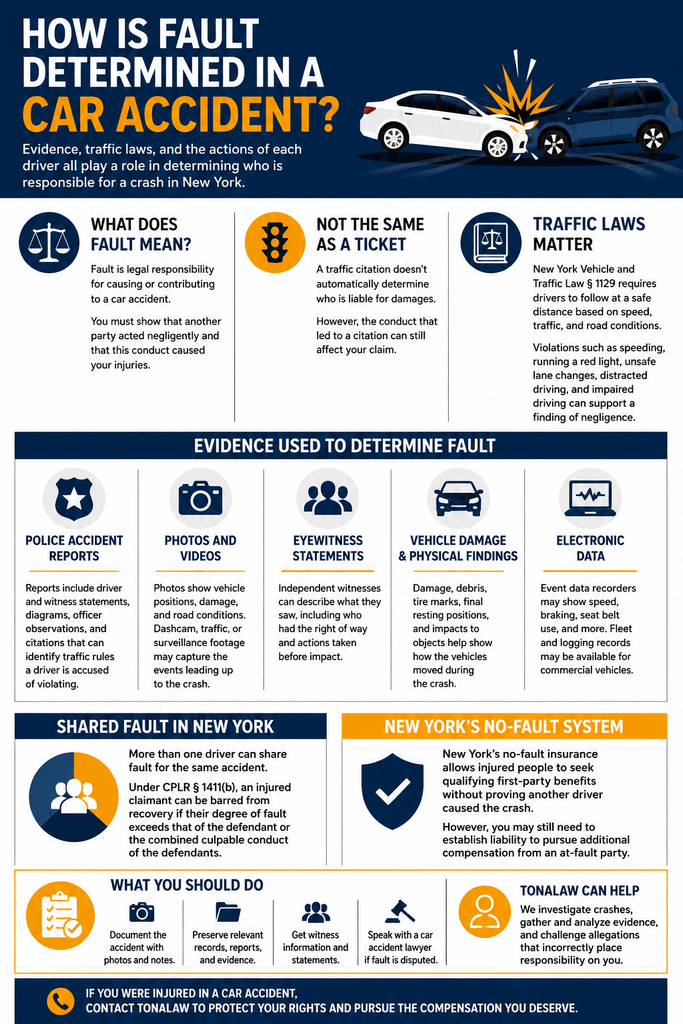
- Police Accident Reports: A police report documents information gathered after the car crash. Driver and witness statements can help establish what happened, while diagrams and officer observations can help identify vehicle positions and points of impact. Citations listed in the report can also identify traffic rules that a driver is accused of violating.
- Photos and Videos: Accident scene photos can document vehicle positions, property damage, and road conditions, all of which can help determine fault. Dashcam footage, traffic cameras, or surveillance footage may capture the events leading directly to impact, such as a vehicle running a red light.
- Eyewitness Statements: An independent and impartial witness who observed the crash could describe which vehicle had the right of way, the direction each driver was traveling, or an action that took place before impact. Witness testimony can then be compared with physical findings and the drivers’ descriptions of the auto accident.
- Vehicle Damage and Physical Findings: Vehicle damage can reveal the location and direction of impact. Debris, tire marks, final resting positions, and damage to roadside objects can provide additional information about how the vehicles moved during the car crash.
- Electronic Data: Many vehicles contain event data recorders that store information associated with an accident. Depending on the vehicle and recording system, available data can include speed, braking, accelerator position, seat belt status, and other recorded parameters. When commercial vehicles are involved, electronic logging and fleet records may provide additional information about vehicle operation.
- Accident Reconstruction: An accident reconstruction specialist uses physical findings, measurements, vehicle damage, electronic data, and principles of physics to analyze how a crash occurred. Reconstruction may establish vehicle speed, travel direction, impact location, or the sequence leading to the collision.
New York’s Vehicle and Traffic Law sets rules for following distance, lane use, traffic signals, right of way, turns, speed, and other driving conduct. When a driver violates any of these rules and causes an auto accident, that violation can help establish negligence. The applicable rule depends on how the crash took place.
- Rear-End Accidents: Vehicle and Traffic Law § 1129 states that a driver can’t follow another vehicle more closely than is reasonable and prudent. In a rear-end collision, investigators can examine following distance, speed, braking, and road conditions to determine why the trailing vehicle failed to stop before impact. New York courts have also held that a rear-end collision with a stopped or stopping vehicle establishes a prima facie case of negligence against the rear driver, who must provide a reasonable explanation to rebut that showing.
- Lane-Change Accidents: Vehicle and Traffic Law § 1128 requires a vehicle traveling on a roadway divided into marked lanes to remain within a single lane as nearly as practicable. This rule is relevant when a driver sideswipes another vehicle, merges into an occupied lane, or crosses a lane marking before a crash.
- Intersection Accidents: Intersection collisions can involve disputes over traffic signals, stop signs, turns, and right of way. Vehicle and Traffic Law § 1110 requires drivers to obey official traffic-control devices unless otherwise directed by a police officer or traffic officer. Other provisions govern conduct such as yielding and making turns at intersections.
- Other Traffic Violations: Exceeding the speed limit, unsafe passing, distracted driving, and impaired driving can also contribute to a finding of fault. The conduct must have contributed to the auto accident for it to support liability for the resulting injuries.
New York uses a no-fault insurance system for motor vehicle accidents. If you’re injured in a crash, you can seek qualifying first-party benefits without proving that another driver caused the accident.
Under New York Insurance Law § 5102, basic economic loss includes medical expenses, certain other health-related expenses, lost earnings (subject to statutory limits), and certain other reasonable and necessary expenses. The statute caps basic economic loss at $50,000 per person. These benefits are generally sought from the applicable no-fault insurer.
When Does Fault Become Important?
Fault becomes important when you pursue a personal injury claim against another driver or responsible party. New York Insurance Law § 5104 limits when a person subject to the no-fault system can recover damages from another covered person. For non-economic losses such as pain and suffering, you must have a “serious injury” as defined by Insurance Law § 5102. This includes:
- Death
- Dismemberment
- Significant disfigurement
- A fracture
- Loss of a fetus
- Permanent losses or limitations involving a body organ, member, function, or system
- A medically determined injury or impairment that prevents you from performing substantially all of your usual daily activities for at least 90 of the 180 days immediately following the bodily injury. (Major legislative reforms enacted on May 27, 2026 removed the temporary 90/180-day category for actions commenced on or after May 26, 2026).
You must still establish liability to recover damages from the at-fault party: no-fault benefits and a civil claim against an at-fault driver address separate situations after a New York car accident.
After a car accident, your first priority should be getting medical attention for injuries and avoiding further danger at the scene. Once you’re safe, take reasonable measures to document the crash and preserve relevant records.
- Call the Police: Report the auto accident to law enforcement and remain at the scene. Responding officers can document driver information, statements, vehicle positions, traffic conditions, and apparent violations. Ask how you can obtain a copy of the accident report for your records.
- Take Photos and Video: If your condition permits, take pictures of the vehicles, property damage, skid marks, and overall accident scene, including traffic signs. Video can also be compelling evidence when claims adjusters are making fault determinations.
- Get Witness Information: Ask witnesses for their names and contact information. An independent witness account can help resolve a later dispute about a traffic signal, lane change, right of way, or another driver’s actions.
- Avoid Speculating About Fault: Stick to what you observed when speaking with police officers, insurers, and other people at the scene. Don’t guess about your speed, distance, or actions if you aren’t certain. Avoid accepting blame before the available information has been reviewed.
- File the Required Accident Report: New York requires you to file an MV-104 Report of Motor Vehicle Accident with the Department of Motor Vehicles within 10 days if someone was injured or killed or if property damage to any one person exceeds $1,000. This filing is separate from a police accident report.
- Keep Accident-Related Records: Retain photographs, videos, medical records, repair estimates, insurance correspondence, receipts, and other documents related to the crash. Keeping these materials together makes them available if a claims adjuster disputes how the accident happened.
- Speak With a Long Island Car Accident Lawyer: Speak with a New York car accident lawyer before giving a recorded statement to the other driver’s insurer or accepting a settlement. An attorney can investigate the crash, preserve available evidence like video and electronic data, contact witnesses, and address disputes over fault.
At TonaLaw, we can also handle communications with insurance companies and respond when an insurer tries to place responsibility on you. If another driver disputes fault, we can evaluate the available information and determine what other records are needed to support your insurance claim.
What If the Other Driver’s Insurance Company Blames You?
Be careful when an insurance adjuster asks you to provide a recorded statement about the accident. Questions about your speed, attention, actions, or observations can affect how the insurer evaluates your role in the crash. This is why you should speak with a personal injury attorney before providing a statement to the other driver’s insurance company.
Disputing an inaccurate allocation of fault is especially important because your percentage of responsibility can reduce your damages or even bar recovery altogether. A car accident lawyer can challenge unsupported allegations and present information establishing how the other driver’s conduct caused the crash.
How Long Do I Have to File a Car Accident Lawsuit in New York?
For most negligence claims involving car accident injuries, CPLR § 214 provides a three-year statute of limitations. This filing period generally begins on the date of the accident. Different deadlines can apply in some cases:
Claims involving a municipality or another public entity can have shorter notice and filing requirements.
Wrongful death claims in New York generally must be filed within two years of the date of death under EPTL 5-4.1
Because the applicable deadline depends on the type of claim and the parties involved, you should speak with a New York personal injury lawyer before assuming you have three years to file.
Determining fault after a car accident can affect your ability to recover damages and the amount you receive. At TonaLaw, we represent people injured in New York car accidents and can thoroughly investigate your accident to support a fault determination. We can also deal with the insurance companies and pursue compensation from those responsible for your injuries. Please call our law firm at 1-833-TONA-LAW or reach out online to schedule a free case review and take the first step toward turning your setback into a comeback.
SHARE


