
Key Takeaways
- Rejecting an insurance settlement doesn’t end your New York car accident claim. You may continue negotiating, make a counteroffer, provide more documentation, or pursue litigation if settlement discussions fail.
- You can counter an insurer’s proposal with a different amount and support your demand with medical records, wage records, accident reports, witness statements, and other documentation.
- Rejecting an offer doesn’t guarantee that the insurer will increase it. The company may stand by its original proposal, make another offer, request more information, or withdraw the offer.
- Once you enter into an enforceable settlement and sign a release, you may lose the right to seek additional compensation for claims included in the agreement, even if your injuries later worsen.
- Settlement negotiations don’t extend New York filing deadlines. Most personal injury lawsuits must be filed within three years, while shorter deadlines can apply to claims involving government entities.
- Before rejecting a settlement, consider your medical expenses, future treatment, lost income, earning capacity, recoverable non-economic damages, fault, available insurance, and any reimbursement claims that may reduce what you receive.
If you’ve received an insurance settlement offer after a car accident, you may wonder whether you’re obligated to accept it. What if it’s made before your treatment is finished and you don’t yet know what your future medical needs are? What if the final prognosis is that you’re no longer able to earn the income you used to?
Fortunately, rejecting an insurance settlement doesn’t automatically end your New York car accident claim. In this guide, we’ll review these options, so that you can best determine what’s right for you.
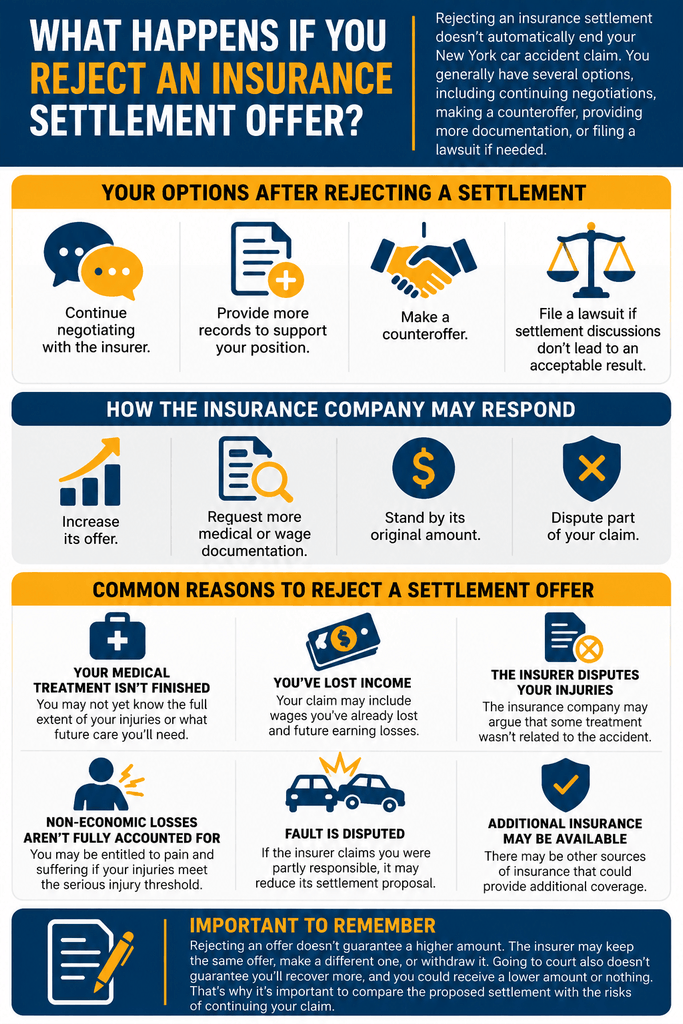
If you reject an insurance settlement offer, your claim remains open. Your options include:
- Continuing to negotiate with the insurer
- Providing more records to support your position
- Making a counteroffer
- Offering a lawsuit if settlement discussions don’t lead to an acceptable result
The insurance company may respond in several ways. It may:
- Increase its offer
- Request more medical or wage documentation
- Stand by its original amount
- Dispute part of your claim
If you make a counteroffer, the insurer may accept it, reject it, or respond with another amount. If the case proceeds to court, negotiations can still continue: many cases settle after several rounds of offers and counteroffers.
Yes. If the insurer’s settlement offer doesn’t account for your financial losses, you can reject it and propose a different amount. A counteroffer gives you the opportunity to explain why the original proposal is too low and present documentation that supports a higher demand.
That documentation may include:
- Medical records and bills
- Records showing future treatment needs
- Wage statements and tax records
- Proof of reduced earning capacity
- Accident reports
- Photos or video from the scene
- Witness statements
- Records showing how your injuries affect your daily activities
A counteroffer doesn’t guarantee that the insurer will agree to your proposed amount. The company may reject it, make another offer, or request more documentation before continuing negotiations. Until an enforceable settlement is reached, you retain the option to continue negotiating or pursue your claim through litigation if necessary.
No. You may continue negotiating with the insurer, submit more documentation, or continue settlement discussions after a lawsuit has been filed. These discussions may involve several rounds of offers and counteroffers before both sides agree on terms.
If negotiations stall, filing a lawsuit may be necessary. But even then, settlement discussions can continue while the case is pending. Both sides may exchange additional offers, attend a settlement conference, or participate in mediation before trial.
It is important to note that going to court doesn’t guarantee you’ll recover more than the insurer offered. A judge or jury may award a higher amount but you could also receive a lower amount or nothing. That’s why it’s important to compare the proposed settlement with the risks of continuing the claim before deciding how to proceed.
There are several reasons you may decide that an insurer’s settlement proposal is too low. The main question is whether the amount accounts for your losses and the effect your injuries are likely to have going forward.
Common reasons include:
- Your Medical Treatment Isn’t Finished: If you’re still receiving treatment, you may not yet know the full extent of your injuries or what future care you’ll need. Accepting a settlement too early can leave you responsible for later expenses that weren’t included in the agreement.
- You’ve Lost Income: Your claim may include wages you’ve already lost because you couldn’t work. If your injuries prevent you from returning to the same job or earning the same income, future earning losses may also need to be considered.
- The Insurer Disputes Your Injuries: An insurance company may argue that some treatment wasn’t related to the accident, that a prior condition caused some of your symptoms, or that certain medical care wasn’t necessary. Those disputes can reduce the amount it initially proposes.
- Your Non-Economic Losses Aren’t Fully Accounted For: New York no-fault benefits don’t compensate you for pain and suffering. However, if your injuries meet the serious injury threshold, you may pursue non-economic damages from the at-fault party.
- Fault Is Disputed: If the insurer claims you were partly responsible for the accident, it may reduce its settlement proposal. New York follows a pure comparative negligence rule, with a modified comparative negligence rule applied specifically to motor vehicle accidents, so being partly at fault doesn’t automatically bar recovery, although your compensation can be reduced by your percentage of fault.
- Additional Insurance May Be Available: Before accepting a settlement, it may be necessary to determine whether other liability policies, umbrella coverage, or supplementary uninsured or underinsured motorist coverage applies.
Yes. If you reject an insurance settlement offer, you shouldn’t assume that the same amount will remain available later. Until the parties reach an enforceable settlement, the insurer may withdraw its proposal, replace it with a different amount, or decide that it won’t increase its original offer.
An insurer may also change its position as new information becomes available. For example, later medical records may affect how it evaluates your injuries, or new evidence may change how it views fault for the accident. The insurer may also set a deadline for accepting an offer, although that deadline doesn’t override your legal rights or the applicable statute of limitations.
Rejecting an offer can still be appropriate if the amount doesn’t account for the compensation available under your claim. The important point is that rejection involves risk. Once you turn an offer down, there’s no guarantee that the insurer will make the same proposal again.
Accepting a settlement is very different from rejecting one. Once you and the insurer have entered into an enforceable settlement, you generally can’t change your mind simply because you later decide the amount was too low.
For a lawsuit that’s already been filed, New York CPLR 2104 states that a settlement agreement must be made in open court, contained in a subscribed writing, or reduced to an order and entered. New York courts generally enforce settlement agreements when the parties have agreed to the material terms.
What Happens After You Sign a Release?
Personal injury settlements usually require you to sign a release giving up your right to pursue claims against the settling party. Once a valid release has been signed, it can prevent you from seeking additional compensation for claims included within its terms.
This can be especially important if your injuries later prove to be worse than expected. In Edwards v. Singer, the plaintiff signed a release after a rear-end collision and later underwent neck fusion surgery after his injuries worsened. The Appellate Division, Fourth Department, upheld dismissal of his lawsuit because the release expressly applied to unknown injuries and future developments arising from known injuries.
A release can sometimes be challenged based on fraud, duress, illegality, mutual mistake, or because it wasn’t fairly and knowingly made. However, New York courts normally place the burden on the person seeking to set the release aside once a signed release has been produced. For that reason, you should review the settlement amount and the terms of the release before signing. Once the agreement becomes binding, reopening the claim can be difficult.
If more than one person or company is responsible for the same injury, settling with one party can affect what you can recover from the others. That makes it important to review the terms of any release before accepting a settlement.
Under New York General Obligations Law § 15-108, releasing one person who is liable or claimed to be liable in tort doesn’t release the other parties unless the agreement expressly says so. However, your claim against the remaining parties is reduced by the greatest of:
- The amount stated in the release
- The amount actually paid for the release
- The released party’s equitable share of the damages
For example, if several drivers contributed to the same crash, settling with one driver may reduce the amount you can later recover from the others. The same rule can apply when several people or businesses share responsibility for the same injury.
A good-faith release also protects the settling party from contribution claims by the remaining tortfeasors. Before accepting a settlement from one party, you should consider how the agreement may affect the amount you can still seek from everyone else involved.
No. Rejecting a settlement offer or continuing negotiations with an insurance company doesn’t extend the deadline for filing a lawsuit.
Under New York CPLR § 214, most personal injury lawsuits must be filed within three years. If the applicable deadline expires while you’re still negotiating with the insurer, you may lose the right to pursue compensation through a lawsuit.
New York courts have also held that settlement negotiations by themselves don’t stop the statute of limitations from running. In limited cases, a defendant may be prevented from relying on the deadline if fraud, misrepresentation, or other misleading conduct caused the claimant to delay filing.
Note: Shorter deadlines can apply when a government entity is involved. For example, when a notice of claim is required for a tort claim against a public corporation, New York General Municipal Law § 50-e requires it to be served within 90 days after the claim arises. Many claims governed by General Municipal Law § 50-i must then be filed within one year and 90 days after the event. For this reason, you shouldn’t assume that ongoing settlement discussions protect your right to sue.
If negotiations continue and you eventually agree on an amount, the next steps may include finalizing the settlement terms, signing a release, and completing any documents needed to end the claim or lawsuit.
If a lawsuit has already been filed, New York CPLR § 5003-a requires a settling defendant to pay the settlement within 21 days after receiving a duly executed release and a stipulation discontinuing the action. Municipalities and certain public entities have 90 days. Different rules also apply when court approval of the settlement is required.
If the defendant doesn’t pay within the applicable period, the plaintiff may be able to enter judgment for the amount stated in the release, along with allowable costs, disbursements, and interest calculated from the date the release and stipulation were tendered.
This means settlement usually has several stages. Reaching an agreement is one stage, signing the required documents is another, and receiving payment follows after the settlement paperwork has been properly submitted.
Before you reject a settlement, compare the proposed amount with the losses tied to your accident and the compensation you may be legally entitled to pursue. You should also consider the risks of continuing negotiations or taking the case to court.
- Your Current Medical Expenses: Review the cost of hospital care, doctor visits, therapy, imaging, prescriptions, and other treatment related to the accident.
- Your Future Medical Needs: If your treatment is ongoing, consider what additional care your doctors expect you’ll need. That may include surgery, rehabilitation, medication, injections, assistive devices, or long-term treatment.
- Your Lost Income: Include wages or other earnings you’ve already lost because your injuries kept you from working.
- Your Future Earning Capacity: If your injuries limit the type of work you can do or reduce the amount you can earn, future income losses may be part of your claim.
- Your Recoverable Non-Economic Damages: In a New York car accident claim, pain and suffering damages may be available if your injuries satisfy the serious injury threshold under Insurance Law § 5102(d). These damages can include pain, physical limitations, and loss of enjoyment of life.
- Fault for the Accident: Under current New York law, your damages may be reduced according to your share of fault. In a motor vehicle personal injury action, you can also be barred from recovery if your share of fault is greater than the fault of the person, or combined fault of the people, from whom you’re seeking compensation.
- Available Insurance: Before accepting an offer, determine what liability coverage applies and if other sources of insurance may be available.
- Liens and Reimbursement Claims: Medicare, Medicaid, workers’ compensation, certain no-fault benefits, and other legally enforceable reimbursement claims may affect how much of a settlement you ultimately receive. Attorney fees and case expenses can also reduce the net amount paid to you.
The decision isn’t simply a choice between taking money now and waiting for a larger payment later. You need to consider the amount being offered, the losses you can prove, the insurance available, and the risks of continuing the claim.
Can I Reject an Insurance Settlement and Change My Mind Later?
Possibly, but the insurer doesn’t have to keep the original offer open after you reject it. Once you turn it down, the company may withdraw the proposal, make a different offer, or continue negotiating from another amount.
If you later decide that the earlier offer was acceptable, you can ask if it’s still available. The insurer may agree to reinstate it, but there’s no guarantee. That’s one reason to review the proposed amount, your medical condition, your income losses, and the available insurance before rejecting a settlement.
How Many Times Can I Reject an Insurance Settlement Offer?
There’s no fixed number of times you can reject an offer during settlement negotiations. You and the insurer may exchange several offers and counteroffers before reaching an agreement.
The larger concern is timing. Negotiations don’t automatically extend the statute of limitations, so you can’t assume that continued discussions protect your right to file a lawsuit. If the filing deadline is approaching, legal action may be needed even if settlement talks are still underway.
Does Rejecting a Settlement Increase the Amount of Money I Can Recover?
No. Rejecting an offer by itself doesn’t increase the value of your claim. A higher settlement generally depends on the evidence supporting liability, the extent of your injuries, your medical treatment, your income losses, future damages, and the insurance available.
If new medical records, wage documentation, witness statements, or other evidence changes how the insurer evaluates the claim, that may affect later negotiations. The insurer can also decide not to increase its proposal.
Can I Reject a Settlement If My Lawyer Recommends Accepting It?
Yes. The decision to accept or reject a settlement belongs to you. Your Long Island car accident lawyer can explain the proposed terms, the risks of continuing the case, the available evidence, possible litigation outcomes, and the effect of signing a release.
You aren’t required to accept a settlement simply because your attorney recommends it. At the same time, you should understand why the recommendation was made before deciding to continue negotiations or litigation.
Rejecting an insurance settlement doesn’t end your claim, but it can change what happens next, which is why you should speak to a personal injury lawyer first. If you’ve received a settlement offer after a New York car accident, contact TonaLaw to discuss your options before signing anything or giving up your right to seek further compensation. Please call our law firm at 1-833-TONA-LAW or reach out online to schedule a free case review and take the first step toward turning your setback into a comeback.
SHARE


