
Key Takeaways
- After a car accident on Long Island, you may seek no-fault benefits for basic economic loss and, when New York law permits, pursue a separate liability claim against an at-fault party for additional damages.
- New York no-fault insurance can pay up to $50,000 in basic economic loss. Note: medical bills, and lost income claims are subject to short filing deadlines.
- To recover damages such as pain and suffering in a qualifying motor vehicle case, you generally must meet New York’s serious injury threshold.
- New York’s current comparative fault rule can reduce your damages or, in some motor vehicle cases, bar recovery if your share of fault exceeds the applicable statutory threshold.
- If settlement negotiations don’t resolve the claim, the case may proceed through formal litigation, including evidence exchange, sworn testimony, pretrial motions, and trial.
- Medical records, accident evidence, insurance documentation, and timely filing can all play an important role in establishing liability, injuries, and recoverable damages.
When you’re injured in a car accident on Long Island, it can lead to two different claims. With one, you seek no-fault benefits for medical expenses, lost earnings, and other qualifying losses. With the other, you may be able to sue the at-fault driver for losses that fall outside the no-fault system, including pain and suffering, provided your injuries meet New York’s serious injury threshold.
At TonaLaw, we represent people injured in motor vehicle crashes throughout New York. In this guide, we explain the car accident process on Long Island, so that you understand your rights and options when a negligent motorist leaves you with serious injuries.
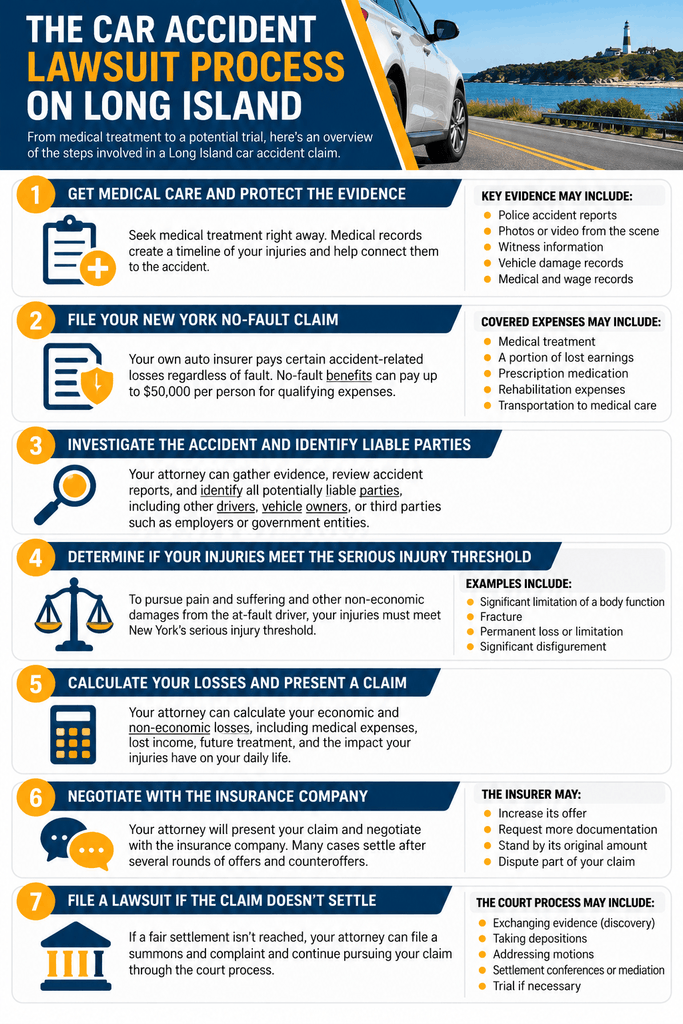
After a car accident on Long Island, your first step should be getting medical treatment. Once your healthcare providers confirm that you’ve suffered compensable injuries, a Long Island car accident lawyer can help you take the following steps:
- Filing a no-fault claim with the appropriate insurer
- Investigating the collision and identifying liable parties
- Determining if your injuries meet New York’s serious injury threshold
- Calculating your losses and presenting a liability claim
- Negotiating with the insurance company
- Filing a summons and complaint if the claim doesn’t settle
- Exchanging evidence during discovery
- Taking depositions
- Addressing motions and continuing settlement discussions
- Proceeding to trial if the parties don’t reach an agreement
New York’s no-fault system may cover certain medical expenses and lost wages regardless of fault, but it doesn’t compensate you for noneconomic damages like pain and suffering. To pursue those damages from the at-fault driver, you may need to show that your injuries meet New York’s serious injury threshold. Now let’s take a closer look at the lawsuit process itself.
After a Long Island car accident, medical records and accident evidence can play a major role in any later injury claim. Seeking medical attention creates a record of your symptoms, diagnoses, treatment, and physical limitations. Those records can help connect your injuries to the collision and document how they affect your daily activities and ability to work.
Medical documentation may include:
- Emergency room records
- Diagnostic imaging
- Physician notes
- Physical therapy records
- Prescription records
- Treatment recommendations
- Work restrictions
- Records of future medical needs
Delays or long gaps in treatment can give an insurance company grounds to question causation or argue that an injury wasn’t as serious as claimed. Following medical recommendations and keeping records of your treatment can help document the progression of your condition.
You should also preserve evidence related to the crash. Useful evidence may include:
- Police accident reports
- Photographs of the vehicles and crash scene
- Dashcam footage
- Surveillance video
- Witness names and contact information
- Vehicle damage records
- Event data recorder information
- Cell phone records when they’re relevant and legally obtainable
- Medical bills
- Wage and employment records
Some evidence, like video or dashcam footage, can disappear or become harder to obtain as time passes. Early evidence preservation can give your attorney a stronger foundation when investigating liability and damages.
New York uses a no-fault insurance system for motor vehicle accidents. This means that your own auto insurer pays certain accident-related losses regardless of who caused the crash. These benefits are separate from a liability claim against an at-fault driver.
New York no-fault benefits can pay up to $50,000 in basic economic loss per person. Depending on the claim, those benefits may include:
- Medical treatment related to the accident
- A portion of lost earnings, sometimes called “lost wages”
- Prescription medication
- Rehabilitation expenses
- Certain transportation expenses related to medical care
- Other reasonable and necessary accident-related expenses allowed under the policy and New York law
No-fault claims are subject to short filing deadlines. Written notice of the accident generally must be submitted to the appropriate insurer within 30 days. Medical providers must submit bills within 45 days after treatment, while claims for lost earnings and other qualifying expenses must be submitted within 90 days. Exceptions may apply when there is a reasonable justification for a late submission.
Note: Receiving no-fault benefits doesn’t prevent you from pursuing a separate liability claim when New York law permits one. No-fault mainly addresses basic economic loss, while a liability claim may seek damages that fall outside the no-fault system.
If you’re a covered person bringing a negligence claim against another covered person for injuries arising from the use or operation of a motor vehicle in New York, you generally must have sustained a “serious injury” as defined by Insurance Law § 5102(d) to recover noneconomic damages.
Under the current statute, a serious injury includes one that results in:
- Death
- Dismemberment
- Significant disfigurement
- A fracture
- Loss of a fetus
- Permanent loss of use of a body organ, member, function, or system
- Permanent consequential limitation of use of a body organ or member
- Significant limitation of use of a body function or system
Note: A 2026 amendment removed the former category for a medically determined non-permanent injury that prevented a person from performing substantially all customary daily activities for at least 90 of the first 180 days after the injury. That change took effect on May 26, 2026, so older discussions of New York’s serious injury threshold may include a category that is no longer part of the current definition. This applies to all lawsuits filed on or after May 26, 2026.
Meeting the serious injury threshold doesn’t necessarily establish that another driver is liable or determine how much compensation you can recover. You still need evidence addressing fault, causation, and damages. At TonaLaw, we review the medical records and accident evidence to determine how the threshold applies to your claim and what compensation may be pursued outside the no-fault system.
A car accident investigation can determine how the collision happened and identify each party that may be legally responsible for your injuries. Depending on what caused the crash, potentially liable parties may include:
- Another Driver: A driver may be liable for conduct such as speeding, following too closely, failing to yield, making an unsafe lane change, or violating another traffic rule.
- The Vehicle Owner: Under New York Vehicle and Traffic Law § 388, a vehicle owner can be liable for injuries caused by negligence when another person operates the vehicle with the owner’s express or implied permission.
- An Employer: An employer may be vicariously liable when an employee causes a crash while acting within the scope of employment.
- Other Drivers: Multi-vehicle crashes often involve negligence by several motorists, so an investigation may need to examine the conduct of each driver involved.
- A Business Connected to a Commercial Vehicle: A trucking company, delivery company, or other business may be liable when its own negligence contributed to the crash or when it is legally responsible for the conduct of the driver.
Identifying every potentially liable party is important because fault can affect both your ability to recover compensation and the amount you may receive. Evidence collected early can also help address competing accounts of how the crash occurred.
Fault can affect both your right to recover compensation and the amount you may receive. New York changed its comparative-fault rule for certain motor vehicle personal injury actions effective May 26, 2026. Under CPLR § 1411(b), if your own degree of responsibility is greater than that of the person or people you’re seeking recovery from, you can be barred from recovering damages.
If your share of fault doesn’t exceed that threshold, your damages can still be reduced according to your percentage of responsibility. For example, if you sustain $200,000 in recoverable damages and are found 20 percent at fault, your award may be reduced by 20 percent, or $40,000.
Comparative fault disputes can arise from allegations that you were speeding, following too closely, distracted, making an unsafe turn, or violating another traffic rule. At TonaLaw, we can examine the evidence used to assign fault and challenge allegations that place responsibility for the crash on you.
Your Long Island car accident attorney can calculate the losses that may be pursued from an at-fault party. Depending on your injuries and losses, a liability claim may seek compensation for:
- Medical Expenses Beyond Basic Economic Loss: You may pursue qualifying medical expenses that exceed or fall outside basic economic loss.
- Lost Income: A claim may include recoverable earnings losses that aren’t included within basic economic loss.
- Reduced Earning Capacity: Injuries that limit your ability to earn income in the future may support a claim for diminished earning capacity.
- Future Medical Expenses: Damages may include qualifying future treatment, rehabilitation, medication, and other medical expenses caused by your injuries.
- Pain and Suffering: If you satisfy New York’s serious injury requirement, you may pursue compensation for pain, suffering, and other noneconomic losses.
- Other Recoverable Losses: Additional economic or noneconomic damages may be available based on the injuries and losses proved in your case.
New York’s collateral source rule can also affect an economic damages award. Under CPLR § 4545, a court may reduce certain awards when it finds that qualifying medical expenses, lost earnings, or other economic losses were or will, with reasonable certainty, be replaced or indemnified by a collateral source like health insurance benefits, disability benefits, Social Security benefits, or employee benefit programs.
New York’s no-fault rules apply to basic economic loss, while a separate liability claim may seek damages recoverable under Insurance Law § 5104. Depending on your losses, a claim may include:
- Medical records and bills
- Proof of lost income
- Documentation of future medical needs
- Photographs and video
- Witness statements
- Police reports
- Evidence concerning vehicle damage
- Records showing how your injuries have affected your work and daily activities
The insurance company may accept liability, dispute who caused the crash, argue that you share responsibility, challenge the connection between the accident and your injuries, or dispute the amount of damages claimed. It may also argue that your injuries don’t satisfy New York’s serious injury threshold when that requirement applies.
Settlement negotiations can take place before a lawsuit is filed. If the parties agree on compensation and any applicable settlement requirements are satisfied, the claim may end without litigation. If they can’t agree on liability or compensation, filing a lawsuit may be the next step.
If settlement negotiations don’t resolve the claim, your attorney may file a personal injury lawsuit against the negligent party or parties. Filing the lawsuit begins the formal court case and allows both sides to use New York’s civil litigation procedures to obtain evidence, question witnesses, and ask the court to rule on disputed issues.
The lawsuit generally begins with a summons and complaint. The complaint identifies the parties, describes the collision, states the legal basis for the defendant’s alleged liability, and identifies the injuries and damages being claimed. In a New York personal injury action, the complaint requests general relief but doesn’t state the dollar amount of damages sought. The defendant must then be served according to New York law and given an opportunity to respond.
A defendant may answer the complaint by admitting or denying allegations and raising affirmative defenses. Those defenses may include comparative fault, challenges to causation, or an argument that your injuries don’t meet New York’s serious injury threshold when that requirement applies.
A Long Island car accident lawsuit may be filed in Nassau County or Suffolk County when New York’s jurisdiction and venue rules permit filing there. Venue may be based on where a party resided when the lawsuit began or where a substantial part of the events giving rise to the claim occurred. Other venue rules can apply depending on the parties involved.
After the lawsuit is filed and the parties have responded, the case generally enters discovery. New York CPLR Article 31 allows the parties to obtain information that is material and necessary to prosecute or defend the action. Discovery can include document requests, depositions, interrogatories, requests for admission, and physical or mental examinations.
The parties may also give sworn testimony at depositions. During a deposition, attorneys for both sides can ask questions about how the crash happened, the extent of your injuries, medical treatment, prior medical history (when relevant), work limitations, and the losses being claimed. Depositions are taken under oath and recorded for later use in the litigation.
Discovery gives both sides access to evidence that may affect liability, comparative fault, causation, the serious injury threshold, and damages. It can also identify disputes that may later be addressed through motions, settlement negotiations, or trial.
After discovery, either side may ask the court to decide certain issues before trial. One common request is a motion for summary judgment under CPLR § 3212. A party seeking summary judgment asks the court to decide a claim or defense without a trial because there is no factual dispute requiring a trial on that issue.
In a car accident lawsuit, motions may address:
- Liability for the collision
- Comparative fault
- Causation
- The serious injury threshold
- The availability of particular claims or defenses
- Other issues that may be decided before trial
Settlement negotiations can continue while the lawsuit is pending. Depositions, medical evidence, court rulings, and other developments may affect each side’s position. If the parties reach an agreement, the case may resolve before trial.
If the case proceeds to trial, the factfinder determines disputed issues that remain. Under the current version of Insurance Law § 5104, in an action seeking noneconomic damages under Article 51, the factfinder must determine the party or parties at fault before deciding if the plaintiff sustained a serious injury. Liability for noneconomic loss can’t be imposed unless a serious injury is established.
No. Most Long Island car accident claims resolve before trial through settlement negotiations, but the timing can vary. A settlement may occur before a lawsuit is filed, during discovery, after depositions, following motion practice, or during pretrial conferences.
A case may proceed to trial when the parties can’t agree on issues such as:
- Who caused the crash
- How fault should be divided
- Whether the injuries meet New York’s serious injury threshold
- Whether the crash caused the claimed injuries
- The amount of damages that should be awarded
If the case reaches trial, the judge or jury decides the disputed issues that remain. A settlement, in contrast, allows the parties to resolve the claim without waiting for a trial verdict.
A Long Island car accident claim can be complicated, especially when you’re trying to recover from serious injuries. At TonaLaw, we can review your accident, deal with the insurance companies, and pursue compensation through settlement or litigation. If you were injured in a car accident on Long Island, please call our law firm at 1-833-TONA-LAW or reach out online to schedule a free case review and take the first step toward turning your setback into a comeback.
SHARE


